Unlocking Imagination: The Best Creativity Toys Under $50 That Inspire Young Minds
In a world increasingly dominated by screens, passive entertainment, and algorithm-driven content, the simple act of creating something from nothing has become more precious—and more rare—than ever. Parents, educators, and gift-givers alike are constantly searching for tools that can ignite a child’s natural curiosity, foster problem-solving skills, and encourage open-ended play. The good news? You don’t need a hefty budget to provide these experiences. For under $50, a treasure trove of creativity toys exists that can transform a rainy afternoon into a workshop of invention, a living room into a laboratory, or a kitchen table into an artist’s studio. This article explores a curated selection of such toys, organized by the type of creative thinking they nurture, proving that the best gifts are not the most expensive ones, but the ones that leave room for a child’s own imagination to take the lead.
Why Creativity Toys Matter More Than Ever
Before diving into specific recommendations, it is worth pausing to understand the deeper value of these toys. Creativity is not merely about arts and crafts; it is a cognitive muscle that requires regular exercise. When a child builds a tower from magnetic tiles, designs a marble run, or mixes colors to create a new shade, they are engaging in divergent thinking—the ability to generate multiple solutions to a single problem. This skill is directly linked to later success in fields ranging from engineering to entrepreneurship. Moreover, open-ended toys that have no single “right” answer teach resilience: when a structure collapses, a child learns to iterate and try again. Toys under $50 are particularly valuable because they strip away the bells and whistles of expensive electronics and force the child to be the primary source of energy and ideas. They are tools for empowerment, not passive consumption.
Building Blocks of Invention: Construction and Engineering Toys
One of the most reliable categories for fostering creativity at a low price point is construction toys. Far beyond the classic wooden blocks of yesteryear, today’s market offers ingenious systems that challenge spatial reasoning and fine motor skills.
Magnetic Tiles: A Modern Classic
A set of 40 to 60 magnetic tiles can often be found for $30 to $45, and they are arguably one of the highest-return-on-investment toys available. These translucent, geometric shapes snap together with satisfying clicks, allowing children to build everything from castles to rocket ships to abstract sculptures. What makes them so creatively potent is their versatility: a tile can be a window, a road, a wall, or even a piece of a kaleidoscope when held up to the light. Children as young as three can enjoy them for simple stacking, while older kids can explore principles of symmetry, balance, and structural engineering. The open-ended nature means that every play session is unique, and the toy grows with the child.
Marble Run Kits
For about $20 to $40, a basic marble run kit provides hours of trial-and-error engineering. Kids must plan the trajectory of a marble, considering gravity, momentum, and angles. The best kits come with an assortment of ramps, tunnels, spirals, and drop-ins that can be reconfigured endlessly. The moment the marble successfully completes a new path is a small triumph of logic and creativity. Moreover, marble runs teach patience and systematic thinking—if the marble flies off the track, the child must diagnose why. It is a physics lesson disguised as pure fun.
Connector Rods and Spheres
Toys like Tinkertoys or similar connector systems (often available for under $30) allow children to build structures with rods, wheels, and connectors. Unlike magnetic tiles, these require a bit more dexterity and planning, making them ideal for ages 5 and up. Children can create working vehicles, animal forms, or abstract geometric shapes. The sheer number of possible configurations is staggering, and the lack of a preset model encourages invention rather than imitation.
The Art of Making: Hands-On Craft and Art Kits
While construction toys appeal to the engineer, art-based toys cater to the visual storyteller. The key here is to choose kits that emphasize process over product—toys that allow for experimentation rather than simply filling in pre-printed outlines.
Watercolor and Mixed-Media Sets
A high-quality watercolor set with a brush, a pad of paper, and a few tools like salt or plastic wrap for texture can be assembled for around $20. Unlike expensive digital tablets, watercolors teach children about color theory, blending, and the unpredictable beauty of wet-on-wet techniques. The toy is the paint itself. Add a pack of oil pastels or chalk (under $15) and you have a complete studio. The creative potential lies in the freedom to paint whatever comes to mind—a sunset, a monster, a memory—without worrying about making it “correct.”
Clay and Modeling Compounds
Air-dry clay and polymer clay kits are incredibly affordable, often priced between $10 and $25. A child can sculpt animals, tiny food items, jewelry, or abstract forms. What makes clay special is its tactile, three-dimensional nature. It strengthens hand muscles, encourages planning (how will the legs support the body?), and allows for revision—if the sculpture doesn’t look right, you can squish it and start over. Several brands offer sets with basic tools like rolling pins and shape cutters, but the most imaginative play often comes from just a lump of clay and a child’s bare hands.
Weaving and Sewing Kits
For older children (ages 7 and up), simple weaving looms or sewing kits designed for beginners can be found for under $30. These toys teach pattern-making, patience, and the satisfaction of creating something functional, like a small pouch or a bracelet. The act of following a pattern while simultaneously making creative choices (color combinations, added embellishments) engages both the logical and artistic sides of the brain. Many kits come with enough materials for multiple projects, providing a sustained creative outlet.
The World in Miniature: Role-Play and Storytelling Toys
Creativity is not only about building or making; it is also about imagining new worlds. Role-play toys that encourage narrative thinking are some of the most powerful tools for cognitive and emotional development.
Flexible Animal and Character Figurines
A set of 10 to 15 realistic animal figurines (such as Schleich or similar brands) can be purchased for $35 to $50. But the magic happens when these figures are combined with a few simple props—a piece of fabric becomes a jungle, a cardboard box becomes a cave. Unlike action figures tied to a specific franchise, generic animals and people allow a child to invent their own storylines. A lion might be a king, or he might be a lost pet; a knight might be a hero, or he might be a villain. There are no scripts. This type of play is directly linked to language development, social understanding, and emotional regulation.
Puppets and Puppet Theaters
A set of hand puppets (animals, people, or fantasy creatures) can be found for as little as $15 to $30. Even a single puppet can spark hours of dialogue and performance. Add a simple puppet theater made from a cardboard box, and the child becomes a writer, director, and actor all at once. Puppets allow children to explore difficult emotions from a safe distance, and they encourage verbal expression and empathy. The simplicity of the toy is its strength—the child must supply the voice, the personality, and the plot.
Story Cubes and DIY Board Games
Story cubes—small dice with pictures on each face—are a brilliant storytelling tool costing around $12. Roll the dice, and create a story based on the images that appear. This game can be played solo or with a group, and it teaches narrative structure, improvisation, and collaboration. Similarly, a blank board game kit (under $25) that includes a board, cards, and markers allows a child to invent their own game rules. This is creativity at its highest level: the child not only plays the game but also designs the system itself.
Science and Discovery: Toys That Spark Curiosity
Finally, creativity is deeply intertwined with scientific thinking. The best science toys under $50 are those that invite hands-on experimentation rather than just reading facts.
Simple Circuit Kits
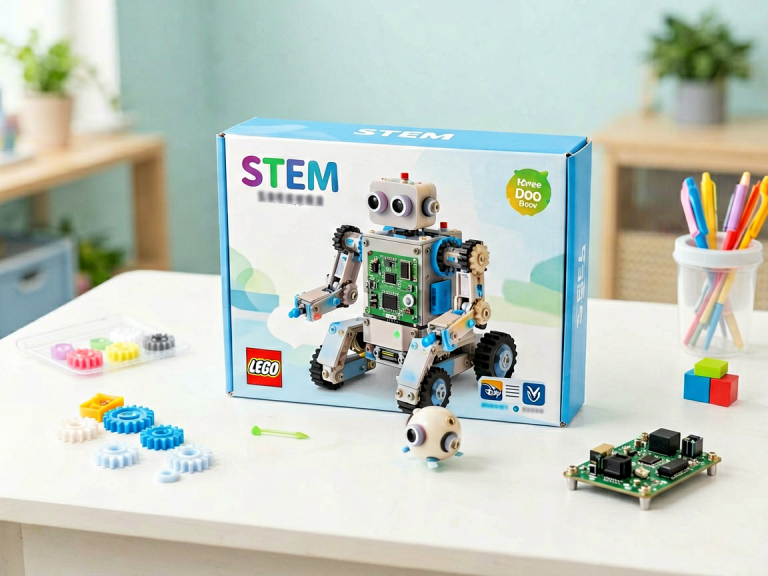
For around $25 to $40, a basic snap-circuit kit allows children to build working lights, fans, and buzzers without soldering. The clear, color-coded pieces snap onto a plastic grid, and the instructions offer dozens of projects. But the real fun begins when children start modifying circuits—what happens if you add a second battery? What if you swap the fan for the light? This is the essence of creative problem-solving. It also demystifies technology, turning a child from a passive consumer of electronics into an active creator.
Microscopes for Young Explorers
A handheld or low-power microscope designed for children (often $20 to $40) can open up invisible worlds. Collect leaves, pond water, or fabric fibers, and examine their structure. The act of discovering something unexpected—like the tiny hairs on a plant stem—ignites a sense of wonder that is the foundation of all creativity. These microscopes are durable and portable, making them ideal for backyard exploration.
Crystal Growing and Chemistry Kits
A crystal-growing kit (about $15 to $30) provides the ingredients and instructions for growing colorful crystals over several days. The waiting process teaches patience, and the resulting crystals are a tangible reward. More advanced chemistry kits (under $50) include safe experiments like making slime, erupting volcanoes, or color-changing solutions. The creative aspect lies in asking “what if”—what happens if you add more baking soda? What if you mix two colors of slime? These questions are the seeds of scientific creativity.
Choosing the Right Toy for the Child
Of course, no toy is one-size-fits-all. A child who is naturally inclined toward order and structure might thrive with a marble run, while a more expressive child might prefer clay or puppets. The key is to observe the child’s current interests and then choose a toy that stretches those interests in a new direction. Also, consider the toy’s “open-endedness”: does it have many possible uses, or does it lead to a single predetermined outcome? The best creativity toys under $50 are the ones that have no instruction manual—or at least, one that the child is likely to ignore.
Another factor is durability. Cheap toys that break easily create frustration, not inspiration. Look for sturdy materials: thick cardboard, non-toxic plastics, and washable fabrics. Many of the toys mentioned above come from reputable brands that prioritize safety and longevity. Spending $40 on a set of magnetic tiles that will last for years is a better investment than spending $10 on a flimsy kit that falls apart after one use.
Conclusion: Less Screen, More Imagination
In an era when a single video game can cost $70 and offer hundreds of hours of scripted entertainment, it is easy to overlook the humble creativity toy. Yet the evidence is clear: children learn most deeply when they are active participants in their own play. A $40 set of magnetic tiles or a $25 puppet collection may not have flashing lights or digital soundtracks, but they have something far more valuable: the potential to become anything. They are catalysts for imagination, not crutches for it.
The next time you are looking for a gift, resist the urge to buy the latest electronic gadget. Instead, consider a creativity toy under $50. You will be giving more than an object; you will be giving a child the chance to build a world, tell a story, solve a puzzle, or discover a passion. And that is a gift that no amount of money can truly replace.