Toys That Beginners Actually Use: A Parent’s Guide to Play That Sticks
Introduction
Walk into any toy store, and you will be bombarded with flashing lights, cheerful jingles, and aisles of plastic promises. Parents of young children often find themselves torn between what looks educational and what actually holds a child’s attention. The reality, however, is that many toys – especially those marketed as “learning tools” – end up collecting dust within days, while a simple cardboard box or a set of wooden blocks becomes the star of the living room. This paradox is particularly acute for beginners: babies, toddlers, and preschoolers who are just discovering the world through play.
What makes a toy truly useful for a beginner? It isn’t the price tag, the brand name, or the number of buttons it has. Instead, it’s the toy’s ability to invite exploration, encourage repetition, and adapt to the child’s changing developmental stage. Beginners need toys that are forgiving, open-ended, and rich in sensory feedback – toys that they can control rather than toys that control them. In this article, we will explore the categories of toys that beginners actually use, not just once but over and over again, and understand why they work so well.
—
The Importance of Open-Ended Play for Beginners
Before diving into specific types of toys, it is essential to grasp why open-ended play is the foundation of meaningful engagement for beginners. Open-ended toys have no single correct way to be used. A set of stacking cups, for example, can be nested, knocked down, used as scoops in a sandbox, or turned into pretend teacups. This flexibility is crucial because young children’s attention spans are short, but their curiosity is limitless.
When a toy is too prescriptive – think of a plastic phone that only plays one song when a button is pressed – a child quickly masters the single action and loses interest. In contrast, open-ended toys grow with the child. A one-year-old might simply bang two blocks together, while an eighteen-month-old might start stacking them, and a two-year-old might use them to represent a house or a car. The same toy continues to offer new challenges as the child’s cognitive and motor skills develop.
Moreover, open-ended play fosters creativity, problem-solving, and a sense of agency. Beginners are still learning that their actions have effects. When they choose how to interact with a toy – rather than being told what to do – they build confidence and intrinsic motivation. This is why the toys listed below are not only played with but are often the very first ones a child reaches for every morning.
—
Sensory Toys That Captivate from Day One
For the youngest beginners – infants and young toddlers – the world is a symphony of new sensations. Sensory toys are designed to engage touch, sight, hearing, and even taste (safely, of course). These are the toys that babies actually use, not merely because they look cute on Instagram, but because they satisfy an innate drive to explore.
Soft Textured Balls and Rattles
A simple ball with different textures – bumps, ridges, soft fabric patches – is a powerhouse of sensory input. Babies grasp, squeeze, and mouth these balls, developing fine motor skills and learning about cause and effect. A good rattle, too, with a gentle sound that is not too loud, encourages a baby to shake it repeatedly, building wrist strength and auditory discrimination. Unlike electronic toys that produce sounds at the press of a button, a rattle lets the baby be the cause of the sound, which is deeply satisfying.
High-Contrast Cards and Mobiles
Newborns have limited vision, and they are naturally drawn to high-contrast patterns (black and white, bold geometric shapes). While these are not toys in the traditional sense, mobiles and cloth cards with such patterns are among the first objects that babies actually focus on and track with their eyes. They stimulate visual development and provide quiet, focused play time – a rare commodity in a world of flashing screens.
Teething Toys with Varied Surfaces
Teething toys are often an afterthought for parents, but they are among the most-used items for babies aged four to twelve months. The best ones are simple silicone shapes with different ridges, bumps, and loops. Babies chew, gnaw, and hold them for extended periods. The key is that they provide relief and sensory feedback simultaneously. Silicone teethers that can be chilled or that have multiple textures keep babies engaged longer than plastic ones.
These sensory toys rarely fail because they appeal directly to the baby’s basic biological drives: to touch, to listen, to put things in the mouth. They do not require batteries or instructions. They simply invite the child to explore.
—
Building and Stacking Toys: The Timeless Champions
If there is one category of toys that beginners use more than any other, it is building and stacking toys. From classic wooden blocks to nesting cups and interlocking plastic bricks, these toys are the bedrock of early childhood play.
Nesting Cups and Stacking Rings
Nesting cups are perhaps the perfect beginner toy. They are lightweight, easy to hold, and offer endless variations: stack them into a tower, nest them inside one another, use them to scoop water in the bath, or line them up like a train. A child as young as six months can start by mouthing the cups, and by twelve months, they can stack two or three. By two years, they are building elaborate towers and pretending the cups are hats or bowls.
Stacking rings follow a similar pattern. The classic cone with rings of different sizes teaches size discrimination and hand-eye coordination. Beginners often spend long minutes trying to put the largest ring on the smallest peg – and failing – but the repetitive trial and error is exactly what their developing brains need. The satisfaction of finally getting it right is a powerful motivator.
Large Wooden or Foam Blocks
Blocks are the definition of open-ended. A one-year-old might knock down a tower built by an adult, laughing each time. An eighteen-month-old might stack two blocks on top of each other and then say “ta-da!”. By age two or three, blocks become houses, towers, bridges, and roads. The beauty of blocks is that they do not dictate a script; the child is the architect.
Research has shown that children who play regularly with blocks develop better spatial reasoning and early math skills. But more importantly, blocks are toys that kids actually use because they are forgiving. A tower falls – no problem, build it again. A block is dropped – it makes a satisfying thud. The physical feedback is immediate and clear, which keeps beginners engaged for long stretches.
Large Interlocking Bricks (Like Duplo)
For children around eighteen months and up, oversized interlocking bricks are a natural progression. They require a bit more finger strength and precision, but the reward of connecting two pieces and seeing a structure grow is immense. Unlike smaller bricks that frustrate beginners, large bricks are easy to handle and can be pulled apart without frustration. Children will spend time sorting them by color, stacking them in patterns, or simply carrying them from room to room – all valuable play behaviors.
—
Imitative and Role-Play Toys: Mirroring the Real World
Between ages one and three, children enter a stage of intense imitation. They want to do what adults do: talk on the phone, cook dinner, clean the house, take care of a baby. Role-play toys that support this imitation are among the most-used toys for beginners because they tap into a powerful psychological drive: the desire to understand and participate in the adult world.
Play Telephones and Toy Keys
A simple play telephone – either a realistic plastic one or a wooden one with a dial – can captivate a toddler for many minutes. They hold it to their ear, babble into it, and press buttons. Similarly, a set of toy keys (plastic or wooden with no sharp edges) is a huge hit because keys are something parents use constantly. Children love to carry them around, pretend to unlock doors, and mimic the jingling sound.
What makes these toys work is their authenticity. A toy phone that actually rings or talks may be fun once, but it quickly becomes repetitive. A simple phone allows the child to create their own conversations, which changes every time. This is why a real, deactivated smartphone (with the screen removed or covered) is often more engaging than a plastic pretend phone – because it feels real to the child.
Toy Kitchen and Food Sets
A small play kitchen with pots, pans, and plastic or wooden food items is a classic that never goes out of style. Beginners love to stir, pour, and serve. They engage in “pretend eating” and offer their creations to parents, building social and language skills. The best kitchens are simple: a stovetop with clicking knobs, a sink, and a few utensils. Overly complex kitchens with electronic sounds and lights actually detract from imaginative play because they dictate what should happen.
Similarly, a set of wooden fruit and vegetables that can be “cut” with a wooden knife is incredibly satisfying for toddlers. The Velcro pieces that stick together and then separate provide fine motor practice and the thrill of “cooking.” Children will use these toys daily, often incorporating them into other play scenarios, such as feeding a doll or serving a teddy bear.
Dolls and Stuffed Animals
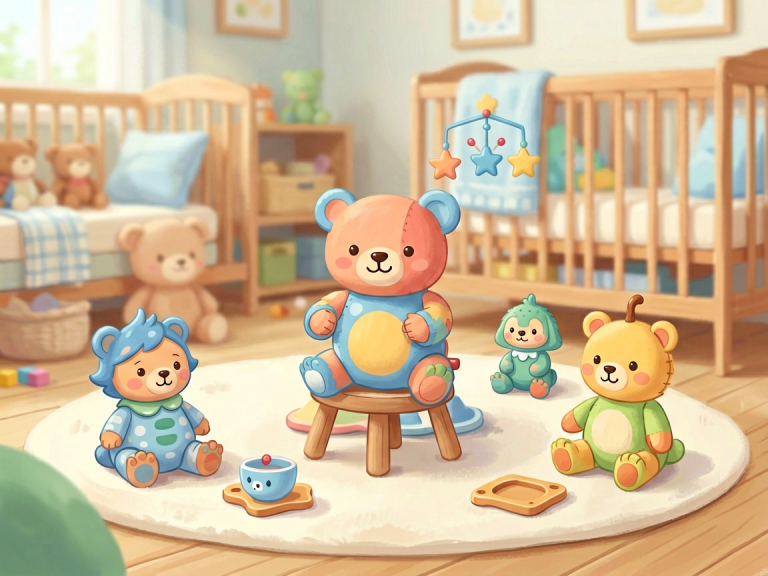
A simple soft doll or a small stuffed animal (with no hard plastic parts) becomes a child’s first companion. Beginners carry them, hug them, put them to bed, and feed them. This is not just cute – it is crucial for emotional development. Through caring for a doll, children practice empathy, learn routines, and process their own experiences. A doll that can be undressed (with simple Velcro or snaps) adds another layer of fine motor practice.
The key for beginners is that the doll or stuffed animal must be soft, safe, and easy to grasp. Tiny buttons or removable clothing pieces that are choking hazards should be avoided. A simple, washable doll with a friendly face and a soft body will be used and loved far more than a fancy, expensive collectible.
—
Movement and Gross Motor Toys: Getting the Wiggles Out
For beginners who are just learning to crawl, walk, or run, toys that encourage movement are essential. These are not just gym equipment; they are toys that children actually use because physical activity is inherently fun for little bodies.
Push and Pull Toys
A wooden push toy with a stick – like a little lawnmower or a wheeled animal – is a staple for toddlers learning to walk. The child holds the handle and pushes it along, feeling the resistance and hearing the wheels click or the bell ring. This helps with balance and coordination. Similarly, pull toys (like a wooden dog on a string) encourage walking backward and turning around, which builds spatial awareness.
What makes these toys work is the cause-and-effect feedback. The child pushes, and the toy moves. The child pulls, and the toy follows. This direct physical connection is far more engaging than a battery-powered car that moves by itself. Beginners want to *be* the motor, not just watch one.
Balls of Various Sizes
A simple ball is arguably the most used toy in human history. For beginners, a soft, lightweight ball (like a cloth ball or a large foam ball) is perfect. They can roll it, chase it, throw it (accidentally or intentionally), and try to catch it. A ball that squeaks or has a bell inside adds auditory interest. Ball play develops hand-eye coordination, gross motor skills, and social turn-taking.
For babies who are not yet mobile, a gentle game of rolling a ball back and forth on the floor while they sit can hold their attention for surprisingly long periods. As they start to crawl, they will chase the ball with determination – a powerful motivator for movement.
Ride-On Toys and Rocking Animals
Once a child can sit up well and has some leg strength, a ride-on toy that they can push with their feet (no pedals) is a huge hit. They feel a sense of speed and control. A simple four-wheeled car or a rocking animal (like a wooden horse) provides vestibular stimulation, which is calming and organizing for the nervous system.
The best ride-ons are lightweight and low to the ground, so that even if they tip over (which they rarely do), the child is not hurt. Many children will spend twenty minutes or more pushing themselves around the room, making engine noises and feeling like they are driving.
—
How to Choose Toys That Will Actually Be Used
After reviewing these categories, a pattern emerges. The toys that beginners actually use share several characteristics: they are simple, durable, open-ended, and respectful of the child’s developmental stage. They do not rely on batteries or screens. They invite rather than instruct.
Prioritize Quality Over Quantity
Parents often feel pressure to have many toys, but a smaller number of well-chosen toys is far more effective. A baby with ten toys might play with each one briefly, but a baby with three or four carefully selected toys will explore each one in depth. Rotating toys (putting some away for a few weeks) can keep interest high without buying more.
Look for Toys That Grow with the Child
When evaluating a toy, ask yourself: “Will my child still use this in six months? In a year?” A set of stacking cups works for infants and preschoolers alike. A simple set of wooden blocks works from age one to age five. Toys that are too specific to a single age often become obsolete quickly.
Resist the Appeal of “Educational” Marketing
Many toys are labeled “STEM” or “Montessori” simply to sell them, but the real test is whether the child naturally gravitates toward them. A wooden puzzle with large knobs is educational in the best sense, but a plastic tablet that teaches letters through flashing lights often fails because the child becomes passive. Trust your child’s interest over the marketing claims.
Observe Your Child’s Play Style
Every beginner is different. Some children love sensory input; others prefer gross motor challenges. A quiet child might love blocks and dolls, while a high-energy child might need push toys and balls. Pay attention to what your child actually reaches for, and invest in more of that type.
—
Conclusion
Choosing toys for beginners can feel overwhelming, but the answer is surprisingly simple: watch the child. The toys that kids actually use are those that respond to their actions, adapt to their creative whims, and provide rich sensory and motor feedback without overwhelming them. A simple wooden block, a textured ball, a set of nesting cups, a soft doll – these are the unsung heroes of early childhood.
They may not look impressive on a shelf, and they certainly do not come with flashing lights or app connections. Yet they are the foundation upon which a child builds confidence, curiosity, and a lifelong love of learning. For parents of beginners, the best investment is not in the trendiest gadget, but in the simplest tools of play – the ones that children will pick up again and again, all by themselves.
So next time you are tempted by a shiny, singing, battery-operated toy, remember: the toys that kids actually use are the ones that let them be the star of the show. Give a beginner a cardboard box and a handful of blocks, and you have given them a universe. That is the kind of toy that never gets old.