The Power of Play: How Educational Logic Toys Shape Young Minds
Introduction: More Than Just Fun
In an era dominated by screens and passive entertainment, the humble toy has undergone a remarkable transformation. No longer仅仅是 tools for passing time, modern playthings have evolved into sophisticated instruments for cognitive development. Among the vast array of options available to parents and educators, educational logic toys for kids stand out as particularly powerful catalysts for intellectual growth. These are not simply colorful objects designed to amuse; they are carefully engineered learning tools that challenge young minds to think critically, solve problems systematically, and develop the foundational skills necessary for academic success and lifelong learning.
The concept of "learning through play" is far from new—pioneers like Maria Montessori and Friedrich Fröbel recognized its importance over a century ago. However, the contemporary understanding of how specific types of play can enhance cognitive functions has deepened considerably thanks to advances in neuroscience and developmental psychology. Educational logic toys, which include puzzles, building sets, pattern recognition games, and strategic board games, target specific areas of brain development, particularly the prefrontal cortex responsible for executive functions such as planning, working memory, and impulse control. As we explore the multifaceted benefits and varieties of these toys, it becomes clear that investing in quality logic-based playthings is one of the most effective ways to support a child's journey toward becoming a capable, confident, and curious individual.
The Cognitive Architecture of Logic Toys
Developing Critical Thinking and Problem-Solving Skills
At their core, educational logic toys are designed to present children with challenges that require systematic analysis and creative solutions. Unlike passive entertainment, these toys demand active engagement. When a child manipulates the pieces of a 3D puzzle or attempts to fit geometric shapes into corresponding slots, they are not merely playing—they are engaging in a process of hypothesis testing, trial and error, and iterative refinement. Each failed attempt provides valuable feedback, teaching the child to adjust their strategy rather than simply give up. This builds what psychologists call a "growth mindset," the belief that intelligence and abilities can be developed through effort and persistence.
Consider, for example, classic wooden tangram puzzles. A child is given seven geometric pieces—five triangles, one square, and one parallelogram—and must arrange them to form a specific shape. This seemingly simple task activates multiple cognitive processes simultaneously: spatial visualization (mentally rotating the pieces), planning (deciding which piece to place first), and logical deduction (determining why a particular combination does or does not work). Research has consistently shown that regular engagement with such puzzles enhances a child's ability to break down complex problems into manageable steps, a skill that translates directly to academic subjects like mathematics and science.
Strengthening Working Memory and Executive Function
Another critical benefit of educational logic toys lies in their ability to train working memory—the brain's ability to hold and manipulate information in the short term. Games like "Simon Says" or electronic memory-matching toys require children to remember sequences of lights or sounds and reproduce them accurately. More advanced logic toys, such as coding board games for preschoolers (e.g., "Robot Turtles" or "Code-a-Pillar"), introduce the concept of sequential commands, where a child must plan a series of moves in advance and hold that plan in mind while executing it. This exercises what neuroscientists call the "central executive" of working memory, which is crucial for following multi-step instructions, mental arithmetic, and reading comprehension.
Moreover, many logic toys incorporate elements of strategy and rule-following, which directly strengthen inhibitory control—the ability to resist impulses and stay focused on a goal. A child playing a simple board game like "Blokus" or "Qwirkle" must learn to wait for their turn, adhere to placement rules, and consider the consequences of each move before acting. These skills are foundational for self-regulation in the classroom and social interactions. Longitudinal studies have demonstrated that children who engage regularly with structured logic-based play show significantly better performance on tests of executive function compared to peers who spend equivalent time on unstructured free play or passive screen time.
Varieties of Educational Logic Toys for Different Ages
Infants and Toddlers: Sensory Foundations
For the youngest learners, logic toys take the form of shape sorters, stacking rings, and simple nesting cups. While these may appear rudimentary, they introduce fundamental concepts of classification, order, and cause-and-effect. A one-year-old who repeatedly attempts to fit a square block into a round hole is not merely being stubborn—they are testing a hypothesis about shape and space. When they finally succeed, their brain registers a pattern that will later serve as the basis for more complex logical reasoning. Montessori-inspired "object permanence boxes," where a ball disappears into a hole and reappears in a tray, teach infants that objects continue to exist even when out of sight, a cognitive milestone critical for later symbolic thinking.
Preschoolers: Building Blocks of Logic
Between ages three and five, children's cognitive abilities expand rapidly, and logic toys should evolve accordingly. Pattern blocks, magnetic tiles, and simple jigsaw puzzles (with 12 to 48 pieces) teach symmetry, geometry, and spatial relationships. At this stage, toys that introduce basic sequencing become invaluable. "Logical" games like "ThinkFun's Roll & Play" or "SmartGames' Day & Night" require children to replicate a given configuration using colored pieces, training their attention to detail and ability to follow visual instructions. Preschoolers also benefit from simple board games that involve matching, counting, or color recognition, such as "Hoot Owl Hoot!" or "The Sneaky, Snacky Squirrel Game," which combine social skills with early mathematical thinking.
Another powerful category for this age group is "cause-and-effect" construction toys. Traditional wooden train tracks and building bricks encourage children to plan layouts, consider how pieces connect, and solve structural problems (e.g., "Why does the bridge keep collapsing?"). These open-ended toys offer endless variations, ensuring that the logical challenges remain fresh and engaging. Importantly, they also foster perseverance—a child who spends twenty minutes trying to balance a tall block tower learns that failure is a stepping stone, not a dead end.
Elementary School Children: Complex Systems and Strategy
As children enter formal schooling, educational logic toys can become more sophisticated, introducing elements of abstract reasoning, algebraic thinking, and computational logic. Strategy board games like "Catan Junior," "Ticket to Ride: First Journey," and "Dragomino" require players to manage resources, predict opponents' moves, and make decisions based on incomplete information—all hallmarks of advanced logical reasoning. These games also naturally incorporate mathematical skills such as counting, arithmetic, and probability estimation in a low-stress, enjoyable context.
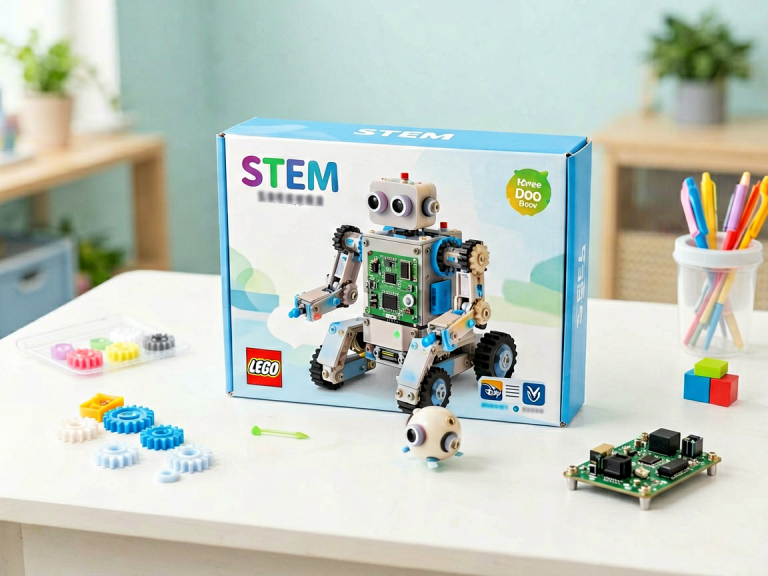
For children who show interest in technology, coding toys designed for ages 6 and up offer an excellent bridge between physical play and digital literacy. Products like "Osmo Coding Starter Kit," "Botley the Coding Robot," and "Lego Boost Creative Toolbox" introduce concepts such as loops, conditionals, and debugging through hands-on activities. Children learn that programming is essentially a form of step-by-step logical instruction—a skill increasingly valued in the modern workforce. Moreover, these toys do not require screen time in the traditional sense; many use physical blocks or cards to control a robot or app, preserving the tactile, active nature of play.
Logic puzzles in book form or as stand-alone toys also become appropriate at this stage. "Sudoku for Kids," "KenKen," and "Griddlers" (nonogram puzzles) train deductive reasoning and pattern recognition. Rubik's Cube-type puzzles, while challenging, provide a powerful lesson in algorithmic thinking: solving a cube requires memorizing and applying a sequence of moves, which is essentially a manual algorithm. Children who master such puzzles often develop a sense of pride and confidence that spills over into their academic work.
Practical Considerations for Parents and Educators
Choosing Quality Over Quantity
With an overwhelming number of "educational" toys on the market, it can be difficult to distinguish genuine learning tools from marketing gimmicks. A good starting point is to look for toys that offer multiple difficulty levels or open-ended possibilities. A single set of pattern blocks can be used by a three-year-old to mimic simple designs and by a ten-year-old to explore fractions and symmetry. Toys that "grow" with the child provide long-term value and sustained intellectual challenge. Additionally, toys that require active, hands-on manipulation are generally more effective than those that rely on lights and sounds to "teach" passively. The best logic toys are those that make the child think, not just respond.
Screen-based logic games and apps can have a place, but they should be used with caution. While some well-designed apps can enhance problem-solving skills, excessive screen time has been linked to attention deficits and reduced creativity. The tactile, social elements of physical toys—touching pieces, moving them around, talking through strategies with a sibling or parent—engage multiple sensory channels and strengthen neural connections in ways that screens cannot replicate. A balanced approach, where physical logic toys form the core of a child's play environment and digital tools are used sparingly and intentionally, is recommended.
The Role of Adult Guidance
While many logic toys are designed for independent play, the presence of a supportive adult can significantly amplify their educational value. When a child becomes frustrated with a puzzle, for example, a parent who asks guiding questions ("What do you notice about that piece? How is it different from the others?") rather than providing direct answers encourages metacognition—the ability to think about one's own thinking. This is a higher-order skill that is strongly correlated with academic success. Similarly, playing board games together provides natural opportunities for teaching turn-taking, sportsmanship, and strategic thinking in a social context.
It is also important to allow children to struggle. In our eagerness to help, we sometimes rob them of the cognitive benefits that come from working through difficulties. The "zone of proximal development"—a concept from psychologist Lev Vygotsky—describes the sweet spot where a task is challenging enough to stimulate growth but not so difficult as to cause despair. Observing a child's response to a logic toy can help parents calibrate the level of support needed, gradually stepping back as the child gains confidence and competence.
Conclusion: Play as a Foundation for Lifelong Learning
Educational logic toys for kids are far more than mere diversions; they are essential tools for cultivating intellectual curiosity, resilience, and analytical thinking. In a world that increasingly values creativity and problem-solving, the habits of mind developed through these toys—persistence, systematic reasoning, flexibility, and self-regulation—are perhaps the most valuable skills a child can acquire. From the simplest shape sorter to the most complex strategy game, each play experience leaves a lasting imprint on the developing brain, building neural pathways that will support learning in school and beyond.
As parents, educators, and caregivers, we have the power to shape these environments thoughtfully. By choosing toys that challenge rather than merely entertain, and by engaging with children in meaningful play, we can help them develop the logical foundations they need to navigate an unpredictable future. The beauty of this approach is that it requires no special training or expensive equipment—just a commitment to valuing play as a serious and joyful endeavor. So the next time you see a child puzzling over a tangram or strategizing over a board game, remember that you are witnessing not just a game, but the architecture of a brilliant mind taking shape. And that, perhaps, is the most important lesson of all.