A Comprehensive Guide on How to Choose Learning Toys for Your Childs Development
In a world overflowing with colorful plastic gadgets, electronic gadgets, and stacks of branded boxes, the simple act of choosing a toy for a child has become surprisingly complex. Parents, educators, and caregivers often find themselves asking: *What makes a toy truly “educational”?* And more importantly, *how do we choose the right learning toys that will not only entertain but also foster genuine cognitive, social, and emotional growth?* This guide provides a deep, research-based framework for selecting learning toys that match a child’s developmental stage, spark curiosity, and avoid the pitfalls of passive entertainment. Whether you are a new parent, a grandparent, or a teacher building a classroom library, these principles will help you make thoughtful, effective choices.
—
1. Understanding Developmental Stages: The Foundation of Toy Selection
The first and most critical step in choosing a learning toy is to align it with the child’s age and developmental stage. A toy that challenges a toddler may frustrate a preschooler, while a toy designed for an older child may pose a safety risk to a baby. Developmental psychology offers clear milestones that can guide your decision.
Infants (0–12 months): At this stage, babies are exploring the world through their senses. They learn about cause and effect, object permanence, and basic motor skills. Ideal toys include soft blocks, rattles, textured balls, and simple mirrors. These toys should be free of small parts and made of non-toxic materials. For example, a set of stacking cups allows a baby to practice grasping, dropping, and later stacking—activities that build fine motor coordination and early problem-solving.
Toddlers (1–3 years): Toddlers are rapidly developing language, mobility, and independence. They engage in parallel play (playing alongside others) and begin to imitate adult activities. Learning toys for this age should encourage exploration and simple problem-solving. Shape sorters, large puzzles with pegs, push-and-pull toys, and pretend-play items like play kitchens or tool sets work well. The key is to choose toys that are sturdy, easy to manipulate, and offer immediate visual or auditory feedback.
Preschoolers (3–5 years): This is the golden age of imagination and symbolic play. Children start to cooperate with peers, follow simple rules, and build early literacy and numeracy skills. Excellent choices include building blocks (like LEGO Duplo or unit blocks), art supplies (crayons, washable paints, modeling clay), board games that involve counting or matching, and storybooks with interactive elements. Toys that require sorting, patterning, or sequencing help develop logical thinking. Also, consider open-ended materials like dress-up clothes, which allow endless storytelling.
School-age children (6+ years): By this stage, children can handle more complex instructions, strategic thinking, and sustained focus. Learning toys can include science kits, robotics kits (e.g., simple programmable robots), advanced construction sets (e.g., LEGO Technic or magnetic tiles), strategy board games (such as chess or Settlers of Catan), and craft kits that teach sewing, knitting, or electronics. The goal is to challenge the child just beyond their current skill level—what the psychologist Lev Vygotsky called the “zone of proximal development.” A good learning toy will stretch a child’s abilities without causing frustration.
—
2. Safety First: Non-Negotiable Criteria for Any Learning Toy
No matter how educational a toy claims to be, if it is not safe, it has no place in a child’s hands. Safety should be your primary filter before considering any other features. Here are essential safety guidelines:
- Age labels are not suggestions: Manufacturers conduct rigorous testing for choking hazards, sharp edges, and toxic materials based on age ranges. Always follow the recommended age on the package, especially for children under three.
- Avoid small parts: For children under three years old, use a small-parts tester (a toilet paper tube) to ensure that no toy component can fit entirely inside it. Loose batteries, magnets, and button-eyed stuffed animals can be dangerous.
- Check for toxic substances: Look for certifications such as EN71 (European standard), ASTM F963 (US standard), or the CE mark. Avoid toys with lead-based paint, phthalates, or BPA. Wooden toys should be finished with non-toxic, water-based paint.
- Determine durability: A learning toy will be thrown, dropped, chewed, and kicked. It should be constructed without sharp edges or splinters. Electronic toys should have secure battery compartments (with screw-on covers) to prevent access to batteries.
- String length: Any cords or strings on toys for young children should be shorter than 12 inches (30 cm) to prevent strangulation.
Once you have verified safety, you can move on to consider the toy’s educational value.
—
3. The Power of Open-Ended vs. Closed-Ended Toys
A crucial distinction in learning toys is whether they are open-ended or closed-ended. Both have their place, but an over-reliance on one type can limit a child’s development.
Closed-ended toys have a single correct outcome. Examples include puzzles, shape sorters, and matching games. These toys teach specific skills: how to fit a square peg into a square hole, how to count to ten, or how to spell simple words. They build persistence, focus, and mastery. However, once the child has mastered the task, the toy often loses its challenge and appeal. Closed-ended toys are excellent for early skill-building but should be rotated and complemented.
Open-ended toys, on the other hand, have no predetermined outcome. They can be used in countless ways: building blocks, clay, sand, water, fabric scraps, cardboard boxes, and art supplies. These toys encourage creativity, divergent thinking, and problem-solving. A child can build a castle with blocks one day and a spaceship the next. Open-ended play supports language development (as children narrate their scenarios), social skills (cooperative story-building), and emotional regulation (working through frustration when a tower falls). Research shows that children who engage with open-ended toys are better at generating original ideas and adapting to new situations.
How to balance them: A well-curated toy collection should include both types. For a toddler, provide a few closed-ended puzzles (e.g., a three-piece animal puzzle) alongside open-ended blocks. For a preschooler, offer a board game that teaches counting (closed-ended) and a box of magnetic tiles (open-ended). Aim for a ratio of about 60% open-ended to 40% closed-ended, adjusting based on the child’s interests and developmental needs.
—
4. Encouraging STEM, Creativity, and Social-Emotional Skills
Modern learning toys often emphasize STEM (Science, Technology, Engineering, and Mathematics), but a well-rounded child also needs toys that foster creativity and social-emotional intelligence. When evaluating a toy, ask yourself: *What skill or domain does this primarily support?*
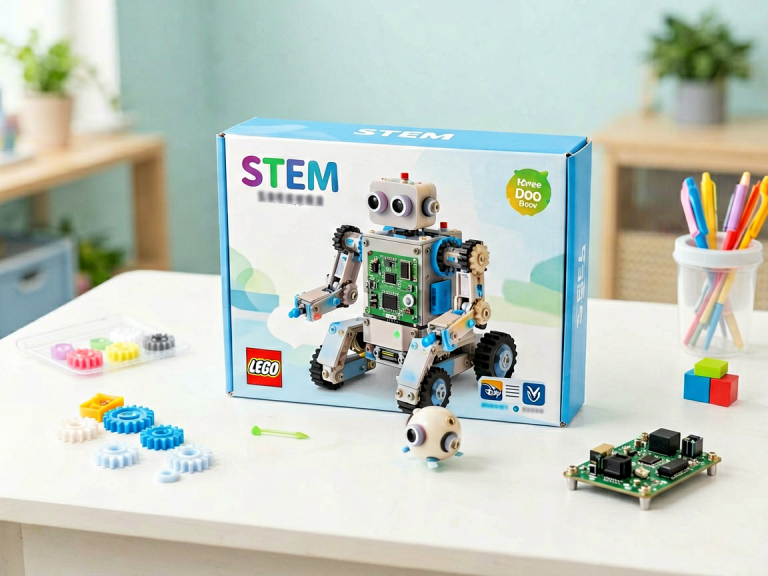
STEM-focused toys: Look for toys that encourage experimentation and logical reasoning. For example, a set of gears teaches cause and effect; a magnifying glass and bug catcher introduces observation; a simple coding toy (like a robot that follows color-coded commands) builds sequencing and problem-solving. Avoid toys that simply present facts (e.g., a talking globe that recites capitals) without allowing the child to manipulate or explore. True learning toys require active participation.
Creativity and the arts: Art supplies—crayons, markers, paints, clay, and collage materials—are arguably the most powerful learning tools. They support fine motor development, self-expression, and decision-making (choosing colors, planning composition). Musical instruments (simple drums, xylophones, shakers) develop rhythm, listening skills, and early math concepts (patterning). Avoid electronic art toys that mimic drawing without actual hand movement; the physical act of drawing or painting strengthens the neural pathways for handwriting.
Social-emotional learning (SEL): Toys that involve cooperation, turn-taking, and empathy are vital. Board games that require players to work together toward a common goal (cooperative games, not competitive) teach teamwork. Puppets and dolls allow children to role-play social scenarios, practice conflict resolution, and express emotions. Playsets like dollhouses or farm sets can be used to discuss feelings, family dynamics, and problem-solving. For older children, strategy games like “Catan: Junior” introduce negotiation and fair play. Research from the American Academy of Pediatrics emphasizes that unstructured play with peers is crucial for developing emotional regulation and communication—toys that facilitate this are priceless.
—
5. Quality over Quantity: Curation and Digital Considerations
In the era of fast fast-fashion toys, it is tempting to buy a large quantity of cheap plastic items. However, a cluttered playroom can overwhelm a child and reduce the quality of their play. Cognitive scientists have found that children engage more deeply with fewer, higher-quality toys that they can rotate. Here are some tips for curating a toy collection:
- The one-in-one-out rule: When you buy a new learning toy, remove an old one that the child has outgrown or lost interest in. This keeps the inventory manageable.
- Look for durability and repairability: A high-quality wooden toy might cost four times as much as a plastic counterpart, but it can last for decades and be passed down to siblings. Avoid toys that break easily or rely on batteries that cannot be replaced.
- Minimize digital and screen-based toys: Many “learning” apps and electronic toys claim to teach but often limit creativity and two-way interaction. The American Academy of Pediatrics recommends that children under two years old have no screen time (except video calls), and that older children’s digital play should be interactive, not passive. If you buy an electronic learning toy, ensure it requires the child to speak, move, or manipulate objects—not just press a button and watch a light flash.
- Seek natural and simple materials: Toys made of wood, fabric, metal, or silicone offer richer sensory experiences than hard plastic. They feel different, smell different, and often have more texture. Natural materials also break down more easily and are better for the environment.
—
6. Practical Recommendations: How to Test a Toy Before Buying
Before purchasing a learning toy, you can run it through a simple checklist. This will save you money and ensure that the toy will actually be used.
- The “Goldilocks” test: Is it too easy, too hard, or just right? A toy that a child can master in five minutes will quickly bore them; one that is too complex will cause frustration. Look for toys that have multiple levels of difficulty or that can be used in different ways as the child grows (e.g., a block set can be used for stacking at age 1 and for building elaborate structures at age 5).
- The “100 uses” test: Imagine the toy in the child’s hands. Can it be used for more than one type of play? For example, a set of wooden rings can be stacked, sorted by color, rolled, threaded, or painted. A single-purpose toy (like a plastic telephone that only makes one sound) will be abandoned quickly.
- The “parent engagement” test: Will this toy encourage you to play with your child, or does it replace you? The best learning toys facilitate interaction—a board game you play together, a building set you create side by side, or a puzzle you solve collaboratively. Toys that “babysit” children (like tablets with passive videos) do not promote deep learning.
- The “longevity” test: Can this toy grow with the child? Some manufacturers design toys with multiple age ranges. For example, a set of magnetic tiles can be used at age 2 for simple stacking, at age 4 for building shapes, and at age 7 for exploring geometry and magnetic polarity. Investing in such toys saves money and reduces waste.
—
7. Conclusion: The Real Gift of a Learning Toy
Ultimately, the best learning toy is one that sparks a child’s natural curiosity, invites them to explore, and does not dictate the outcome. It is a tool—not a teacher. As you walk through toy stores or scroll through online listings, remember that the most educational toys are often the simplest: a set of blocks, a pile of art supplies, a collection of natural objects like sticks and stones. They require the child to imagine, to create, to fail, and to try again. They build resilience, problem-solving, and a love for learning that will last a lifetime.
When you choose a learning toy, you are not just buying an object; you are creating an invitation. You are saying to the child, “Here is a puzzle for your mind. Here is a canvas for your imagination. Here is a problem for you to solve.” And that invitation, when given thoughtfully, is the greatest gift a parent or educator can offer.
So next time you find yourself overwhelmed by the aisle of blinking, beeping gadgets, take a deep breath. Ask the questions: *Is it safe? Does it match the child’s stage? Can it be used in multiple ways? Will it make us talk, laugh, and learn together?* If the answer is yes, you have found a true learning toy.