The Unplugged Imagination: Why Screen-Free Open-Ended Toys Are Essential for Child Development
In an era where toddlers swipe tablets before they can tie their shoes, and preschoolers recognize app icons faster than alphabet blocks, the toy industry has been flooded with flashing, talking, and screen-based gadgets. Yet a quiet counter-movement is gaining momentum among educators, pediatricians, and parents: the return to screen-free open-ended toys. These are not the latest electronic marvels with pre-programmed responses, but simple, timeless objects—wooden blocks, loose parts, art supplies, sand, water, and fabric scraps—that invite endless possibilities. Unlike closed-ended toys that dictate a single correct way to play, open-ended toys have no fixed purpose, no right or wrong answer, and no screen to stare at. This article explores why these seemingly “primitive” playthings are actually powerful tools for nurturing creativity, cognitive flexibility, emotional resilience, and social skills in children. As we navigate a world saturated with digital distractions, understanding the profound benefits of screen-free open-ended play is not nostalgic yearning—it is a developmental necessity.
The Definition and Philosophy of Open-Ended Toys
To appreciate the value of open-ended toys, one must first understand what distinguishes them from their closed-ended counterparts. A closed-ended toy, such as a battery-operated robot that recites the alphabet or a puzzle with a predetermined solution, has a specific learning outcome built into its design. The child’s role is to follow instructions, press buttons, or complete a task. While such toys can teach isolated skills, they often leave little room for interpretation, experimentation, or creative divergence. In contrast, an open-ended toy—a set of wooden planks, a pile of colorful scarves, a container of modeling clay—offers no instructions, no sounds, no flashing lights. Its value lies entirely in what the child brings to it. A single wooden block can become a car, a phone, a castle tower, a bridge, or a monster’s tooth, depending on the child’s imagination at that moment.
The philosophy behind open-ended toys is deeply rooted in constructivist learning theories, particularly those of Jean Piaget and Maria Montessori. Piaget emphasized that children actively construct knowledge through hands-on interaction with their environment. Open-ended toys provide the raw material for this constructive process: they allow children to test hypotheses, manipulate variables, and create their own meaning. Montessori, meanwhile, championed materials that are self-correcting and allow for repetition and concentration. While her materials are often structured, many modern interpretations stress the importance of “free work” with simple, adaptable objects. Moreover, the “loose parts” theory popularized by architect Simon Nicholson argues that the degree of creativity and inventiveness in any environment is directly proportional to the number and variety of variables available to manipulate. Screen-free open-ended toys embody this principle: they are rich in variables—texture, weight, color, shape, sound (when banged or dropped), and infinite combinatorial possibilities—that invite exploration without a script.
Cognitive and Creative Benefits: Building More Than Structures
The cognitive advantages of open-ended play extend far beyond the immediate pleasure of building a tower or drawing a picture. One of the most significant benefits is the development of executive functions—the mental processes that enable self-regulation, working memory, and cognitive flexibility. When a child decides to construct a bridge out of blocks, they must plan, hold a mental image of the desired outcome, adjust as blocks fall, and persist despite frustration. This recursive loop of goal-setting, action, observation, and revision is a foundational exercise for problem-solving skills that last a lifetime. A study published in the journal *Child Development* found that children who engaged in more complex, self-directed pretend play using open-ended materials showed higher scores on measures of executive function and self-regulation compared to those who primarily used digital toys or highly structured toys.
Creativity, too, flourishes in the absence of predetermined outcomes. Open-ended toys demand what psychologist Joy Paul Guilford termed “divergent thinking”—the ability to generate multiple unique solutions to a single problem. Given a handful of wooden blocks, one child might build a house, another a spaceship, and a third a musical instrument by tapping them in rhythmic patterns. There is no “right” answer, so the child’s mind is free to roam, hypothesize, and even fail without shame. This process strengthens neural pathways associated with flexibility and innovation. In contrast, screen-based toys often reward convergent thinking—finding the single correct answer programmed by the designer. While that has its place, an overreliance on closed-ended digital toys can narrow a child’s cognitive toolkit.
Furthermore, open-ended toys naturally promote STEM thinking in a pure, unmediated form. Consider a child pouring water from a small cup into a large bowl: they learn about volume, gravity, flow, and conservation, not through a narrated app but through real physical experimentation. A child stacking stones observes balance, center of gravity, and friction. These are not abstract concepts delivered by a screen; they are tangible realities discovered through the hands. Research from the University of Cambridge has shown that children who play with open-ended materials like sand, water, and blocks develop stronger spatial reasoning skills, which are predictive of later success in mathematics and engineering. The absence of a screen means the child is fully present in three-dimensional space, engaging proprioceptive senses and fine motor skills simultaneously—an integrated learning experience that no digital simulation can replicate.
Social and Emotional Development Through Unstructured Play
Beyond cognition, screen-free open-ended toys serve as powerful catalysts for social and emotional growth. When children play together with loose parts—building a fort with blankets and chairs, staging a puppet show with socks, or negotiating roles in a pretend supermarket—they engage in complex social dynamics. They must communicate ideas, resolve conflicts over toy allocation, and coordinate actions toward a shared goal. Because open-ended toys have no fixed rules, children must invent and agree upon a framework for play. “This block is the cash register!” “No, it’s the cake!” and then they must negotiate a compromise. These micro-interactions teach empathy, perspective-taking, and compromise in ways that structured digital games, with their rigid algorithms, seldom do.
Emotional resilience is another hidden gift of open-ended play. A child who builds a tall tower only to see it crash gathers valuable information about disappointment, persistence, and impermanence. There is no “game over” screen, no status bar, no chance to press “retry” instantly. Instead, the child must experience the raw emotion of loss, decide whether to rebuild or try a different approach, and learn that failure is a natural part of creation. This “productive frustration,” as developmental psychologists call it, builds an internal locus of control and a growth mindset. Children come to understand that effort and adaptation, not a programmed success button, lead to achievement. In an age where digital games often offer endless second chances and immediate rewards, unstructured play with physical objects provides a crucial counterbalance of authentic, embodied experience.
Additionally, open-ended toys are inherently inclusive. They do not require literacy, language fluency, or fine motor proficiency to begin. A child with a disability, a child who is an English language learner, or a child with a different cultural background can all engage with a pile of sticks and stones on equal footing. The play adapts to the child, not the other way around. This democratization of play fosters a sense of belonging and reduces the competitive anxiety that often accompanies closed-ended games or screen-based challenges. It allows children to experience play as pure exploration rather than as performance or comparison.
Practical Strategies for Choosing and Incorporating Open-Ended Toys
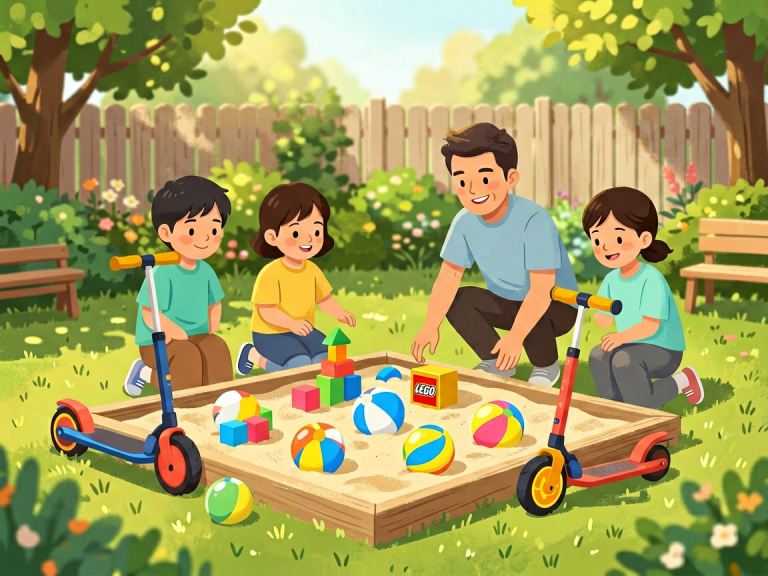
Given the overwhelming evidence of their value, how can parents, educators, and caregivers effectively integrate screen-free open-ended toys into daily life? The first step is to shift perspective from “buying toys” to “curating materials.” The most powerful open-ended playthings are often the simplest: wooden blocks of various shapes and sizes, a set of stacking cups, fabric scraps, ribbons, cardboard boxes, natural objects like pinecones and shells, and basic art supplies such as paper, paint, and clay. The key is variety in texture, weight, size, and potential use, not in electronic features. A simple wagon of sand and scoops can provide hours of deep engagement, while an expensive plastic toy that only makes one sound will quickly be abandoned.
Second, resist the urge to direct play. An adult’s instinct to say “Look, I can build a castle!” can inadvertently impose a structure that limits a child’s imagination. Instead, model curiosity without instruction. Sit nearby and explore the materials yourself, narrating your own process: “I wonder what happens if I put this block on its side…” or “This fabric feels so soft. I think I’ll drape it over this chair.” The child will observe and imitate the language of exploration rather than the language of prescribed tasks. Additionally, avoid the temptation to “fix” a child’s play. If they stack blocks in an unstable way, let them discover the physics themselves. The learning is in the wobble and the fall, not in your intervention.
Third, create an environment that minimizes distraction. Just as importantly, keep screens out of the play space. A nearby TV or tablet, even if turned off, can exert a gravitational pull on attention. Designate a play corner or room that is screen-free, where open-ended materials are displayed invitingly on low shelves where children can access them independently. Rotating materials—putting some away and bringing out new ones every few weeks—maintains freshness without overwhelming the child. And remember: the best open-ended toy is often the simplest one that the child has chosen to use freely. A stick from the backyard can be more imaginative than the most expensive designer block set.
Finally, embrace boredom. Many parents panic when a child says, “I’m bored,” and immediately offer a screen. Yet boredom is the prelude to creativity. When a child has no ready-made entertainment, they must dig into their inner resources and the materials around them to invent something new. Providing open-ended toys during these moments of restlessness invites them to cross that threshold into genuine, self-directed play. Over time, they will develop the stamina and confidence to initiate their own projects without external stimuli.
Conclusion
In a culture that markets quick-fix digital entertainment and rote educational toys, the humble open-ended object stands as a quiet revolutionary. Screen-free open-ended toys do not talk, do not grade, do not flash rewards—and that is precisely their power. They return the agency of play to the child, inviting them to become architects of their own imaginary worlds, problem-solvers of their own physical puzzles, and negotiators of their own social dramas. They build brains that are flexible, resilient, and creative. They build hearts that are patient, collaborative, and empathetic. As we raise the next generation in an increasingly screen-saturated world, choosing simple, open-ended materials is not a step backward; it is a leap forward into deeper learning, richer connection, and more vibrant humanity. Let us give children the gift of empty boxes, piles of sand, and armfuls of fabric—and trust that their unplugged imaginations will fill those spaces with wonders no app could ever contain.