The Ultimate Guide to Learning Toys for Parents: Fostering Growth Through Play
Introduction
Every parent wants the best for their child, and when it comes to early development, the role of play cannot be overstated. In recent years, the market has been flooded with toys marketed as “educational,” “learning,” or “developmental,” leaving many parents feeling overwhelmed. How do you separate genuine learning tools from gimmicks? Which toys truly support cognitive, social, and motor skills at each stage of childhood? This guide aims to provide a clear, research-based framework for choosing learning toys that nurture curiosity, creativity, and critical thinking. By understanding the principles behind effective educational playthings, you can turn your child’s playroom into a rich environment for growth—without breaking the bank or succumbing to marketing hype.
—
Understanding the Role of Learning Toys in Child Development
Learning toys are not simply substitutes for formal education; they are powerful catalysts for holistic development. When a child stacks blocks, solves a puzzle, or pretends to cook in a play kitchen, they are engaging in activities that build neural connections. According to developmental psychologists, play enhances executive function (the ability to plan, focus, and self-regulate), language acquisition, spatial reasoning, and social-emotional intelligence.
The best learning toys are those that encourage active participation rather than passive consumption. A toy that lights up and plays a song may entertain a baby for a few moments, but a simple set of wooden rings on a wobbling base invites the child to explore cause and effect, hand-eye coordination, and persistence. Similarly, a construction set that can be assembled in multiple ways fosters divergent thinking—the ability to generate many solutions to a single problem. As you read through this guide, remember that the most valuable toys often look deceptively simple. They are tools for discovery, not for instant gratification.
—
Age-Appropriate Learning Toys: A Breakdown
Selecting toys that match your child’s developmental stage is crucial. A toy that is too advanced may frustrate, while one that is too simple may bore. Below is a stage-by-stage guide to the types of learning toys that align with typical milestones.
Infants and Toddlers (0–2 Years)
During the first two years, children learn primarily through sensory exploration and motor development. Look for toys that engage the senses—texture, sound, color, and weight.
- Sensory toys: Soft fabric books with crinkle pages, textured balls, and rattles help babies refine touch and hearing.
- Stacking and nesting toys: Simple wooden rings or cups teach cause and effect, fine motor control, and early concepts of size and order.
- Object permanence boxes: A ball dropped into a hole disappears and reappears, helping infants grasp that objects exist even when out of sight.
- Teethers and grasping toys: These strengthen hand muscles and oral motor skills.
Avoid electronic toys with flashing lights for this age group; they can overstimulate and limit natural exploration.
Preschoolers (2–4 Years)
Toddlers become more mobile and imaginative. Language skills explode, and they begin to engage in pretend play.
- Puzzles with knobs and chunky pieces build problem-solving and fine motor precision. Start with two- or three-piece puzzles, then increase complexity.
- Shape sorters and pegboards reinforce shape recognition, color matching, and hand-eye coordination.
- Pretend play sets: Play kitchens, tool benches, doctor kits, and dollhouses encourage storytelling, empathy, and social role-playing.
- Simple board games (e.g., matching games, Candy Land) introduce turn-taking, following rules, and early counting.
At this age, children also benefit from musical instruments like xylophones or tambourines, which support auditory discrimination and rhythm.
Early School Age (4–6 Years)
Now children are ready for more structured problem-solving and extended focus. Their fine motor skills allow for precise manipulation, and their curiosity about “how things work” blossoms.
- Building and construction sets (LEGO Duplo, magnetic tiles, wooden blocks) promote spatial awareness, engineering thinking, and creativity.
- Early science kits: Simple magnet sets, bug viewers, or water-play experiments encourage observation and hypothesis testing.
- Board games with counting and strategy: Games like *Sequence for Kids* or *Hoot Owl Hoot* teach cooperative strategy and number sense.
- Art supplies: Safety scissors, glue, modeling clay, and washable paints allow open-ended creation, which supports emotional expression and design thinking.
Avoid toys that have a single “right” answer; instead, choose those that invite multiple outcomes.
School Age and Beyond (6+ Years)
Older children can handle complex logic, abstract concepts, and collaborative projects.
- Coding and robotics toys (e.g., Botley, LEGO Boost, Ozobot) introduce sequencing, debugging, and algorithm thinking without requiring a screen for hours.
- Advanced construction sets (LEGO Technic, K’NEX, marble runs) challenge children to follow diagrams and solve mechanical problems.
- Science experiment kits (crystal growing, volcano, electricity) foster methodical inquiry and patience.
- Strategy board games (Chess, Settlers of Catan Junior, Blokus) enhance planning, resource management, and perspective-taking.
At this stage, digital learning tools (educational apps, interactive e-books) can be beneficial when used in moderation, but they should complement—not replace—hands-on manipulation.
—
Key Types of Learning Toys and Their Benefits
Not all learning toys fit neatly into one category. However, understanding the main types can help you balance your child’s play diet.
STEM Toys: Building Future Problem-Solvers
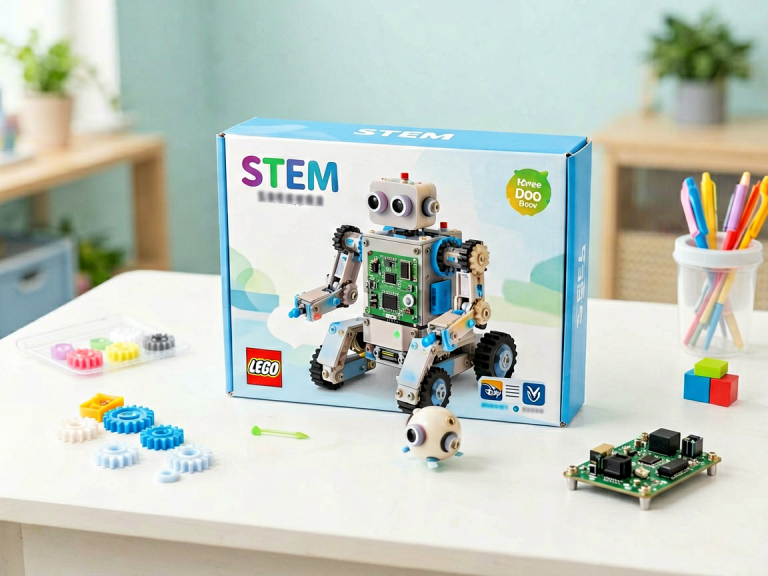
STEM (Science, Technology, Engineering, Mathematics) toys are designed to develop logical thinking and curiosity about the physical world. Examples include magnetic building tiles, simple circuit kits, and gear sets. These toys teach children to experiment, fail, and try again—a resilience that translates into academic confidence. Look for open-ended STEM toys that allow for multiple designs rather than a single assembly.
Language and Literacy Toys: Cultivating Communication
From alphabet puzzles and phonics games to storytelling cards and magnetic word tiles, language toys support vocabulary growth, phonemic awareness, and narrative skills. Bilingual toys can also introduce a second language naturally. The key is interaction: a toy that simply says a word is less effective than one that invites the child to form sentences or create stories.
Creative and Artistic Toys: Nurturing Expression
Art toys—such as watercolor sets, clay, collage materials, and musical instruments—allow children to process emotions and explore aesthetics. Unlike structured activities, open-ended art encourages decision-making and self-confidence. Even simple finger painting can strengthen motor skills and color theory knowledge.
Social and Emotional Learning (SEL) Toys: Building Empathy
Dolls, action figures, puppets, and cooperative board games teach perspective-taking, sharing, and conflict resolution. A dollhouse, for instance, lets a child act out family dynamics, practice conversations, and explore feelings in a safe space. Games where everyone wins together (rather than against each other) foster collaboration over competition.
—
How to Evaluate the Quality and Safety of Learning Toys
With so many options on the market, a few criteria can help you judge a toy’s true value.
Safety first: Always check for non-toxic materials (BPA-free, lead-free paint), sturdy construction (no sharp edges), and age warnings. Avoid small parts for children under three. Look for certifications like ASTM or CE marks.
Durability and longevity: A good learning toy should survive years of play. Wooden toys often outlast plastic ones and can be passed down. Avoid toys that rely on batteries for their main function—they often break or become obsolete quickly.
Open-endedness vs. closed-ended: Open-ended toys (blocks, playdough, loose parts) can be used in countless ways, growing with the child. Closed-ended toys (puzzles, single-purpose electronic gadgets) have a limited learning window. Aim for a healthy mix, but prioritize open-ended items for maximum return on investment.
Alignment with real-world skills: Does the toy encourage independent thinking? Does it require patience? Does it spark conversation? A toy that a child can master in five minutes and then ignore is not a learning tool—it’s a distraction.
—
Practical Tips for Parents When Selecting Learning Toys
Even with the best intentions, it’s easy to overbuy or choose toys that end up ignored. Here are some down-to-earth strategies.
- Observe your child’s interests. A child who loves dinosaurs may learn more from a dinosaur excavation kit than from a generic science set. Follow their passion, and learning becomes effortless.
- Adopt a “less is more” philosophy. Having too many toys can overwhelm a child and reduce the depth of play. Rotate toys in baskets every few weeks to keep novelty alive without clutter.
- Include your child in the selection process. When possible, take them to a store or let them browse a catalog. Their choice may surprise you—and they’ll be more invested in playing with it.
- Prioritize collaborative play. Choose toys that can be shared with siblings or friends. Cooperative games and building kits teach social skills that individual digital devices cannot substitute.
- Avoid over-scheduling play. Let your child lead. A learning toy becomes truly educational when the child has the freedom to explore it in their own way, at their own pace.
- Screen out “educational” marketing gimmicks. Many toys claim to teach advanced subjects like “quantum physics for toddlers” but offer only superficial engagement. Trust your instincts: if the toy doesn’t inspire curiosity or hands-on interaction, it’s probably not worth the price.
—
Conclusion
Choosing learning toys for your child is not about finding the perfect product; it’s about creating an environment that values exploration, failure, and joy. The best toys are those that invite questions, allow for mistakes, and spark meaningful interaction—between the child and the toy, and between the child and you. As you navigate the aisles or scroll through online listings, remember that you are your child’s first and most important playmate. A simple cardboard box and a handful of crayons can be more educational than the most expensive gadget if you share the experience with laughter and encouragement. Use this guide as a compass, but trust your knowledge of your child. After all, no one knows their unique strengths, interests, and challenges better than you. Happy playing, and happy learning.