Navigating the World of Robot Toys: Age-Based Recommendations for Safe and Educational Play
The modern toy aisle has transformed dramatically over the past decade. Among the colorful dolls, building blocks, and board games, a new category has taken center stage: robot toys. These interactive, often intelligent playthings range from simple light-up creatures to complex programmable machines that can dance, talk, and even learn from their environment. For parents, grandparents, and educators, the appeal is clear—robot toys promise more than just entertainment; they offer a gateway into science, technology, engineering, and mathematics (STEM) learning. However, with this explosion of options comes a pressing challenge: how to choose the right robot toy for a specific child. The manufacturer’s age recommendation is not merely a legal disclaimer; it is a critical guide that balances safety, developmental readiness, and educational value. Selecting a robot that is too advanced can lead to frustration and disengagement, while one that is too simple may bore the child and miss the chance to cultivate curiosity. This article provides a comprehensive, evidence-based overview of robot toy age recommendations, breaking down the key considerations across different developmental stages. From the sensory explorations of a toddler to the sophisticated coding projects of a teenager, understanding these age brackets will empower caregivers to make informed choices that nurture both fun and learning.
Why Age Recommendations Matter: Safety and Developmental Fit
Age recommendations printed on robot toy packaging serve two fundamental purposes: safety compliance and developmental appropriateness. Safety is the primary concern, especially for younger children. Many robot toys contain small parts—screws, gears, or detachable sensors—that pose choking hazards for children under three. Others include button batteries, which, if swallowed, can cause severe internal burns within hours. Sharp edges, long cords, and magnetic components also present risks that are clearly evaluated by regulatory bodies such as the Consumer Product Safety Commission (CPSC) in the United States or the European Union’s Toy Safety Directive. Manufacturers must test toys for mechanical strength, flammability, and chemical safety before assigning an age grade. Parents should never ignore these warnings, even if their child seems precocious. The second dimension—developmental fit—is equally important but often underestimated. A robot toy designed for an eight-year-old typically requires fine motor skills, reading comprehension, and abstract reasoning that a five-year-old has not yet developed. For instance, a programmable robot that relies on a tablet app for coding demands sustained attention and sequential thinking. When a child is not ready for these cognitive demands, the toy becomes a source of frustration rather than delight. Conversely, a toy that is too simple for a child’s current abilities offers little challenge and fails to stimulate growth. The ideal robot toy sits in the “zone of proximal development”—just beyond what the child can do alone but achievable with guidance. Age recommendations provide a starting point, but they must be interpreted with the child’s individual interests, attention span, and prior exposure to technology in mind. Moreover, digital privacy is an emerging concern: some modern robot toys connect to Wi-Fi or collect voice data. Parents should check for data encryption and whether the toy complies with privacy regulations like COPPA (Children’s Online Privacy Protection Act). In summary, age recommendations are not arbitrary numbers; they are a carefully crafted intersection of physical safety and cognitive readiness, and respecting them is the first step toward a positive robotics experience.
Robot Toys for Ages 0–3: Sensory Exploration and Simple Interaction
For infants and toddlers, the world is a symphony of sensations, and robot toys designed for this stage should prioritize safety, simplicity, and sensory engagement. Children aged zero to three are developing foundational skills: hand-eye coordination, cause-and-effect understanding, and emotional bonding. Consequently, the best robot toys for this age group are those that respond to basic actions—pressing a button, touching a sensor, or shaking the toy—with gentle lights, soothing sounds, or gentle movements. Examples include Fisher-Price’s “Laugh & Learn” series robots that sing songs and light up when a baby presses a large button, or the “Tiny Love” musical robot that rolls slowly across the floor, encouraging crawling. Crucially, these toys must have no small detachable parts and should be large enough to avoid swallowing. Materials should be non-toxic, BPA-free, and easy to clean, as toddlers inevitably put everything in their mouths. Batteries must be securely enclosed with a screw-lock compartment to prevent curious fingers from accessing them. Additionally, volume levels should be limited to protect young ears—the American Academy of Pediatrics recommends that toys for infants produce sounds no louder than 65 decibels. Robot toys at this stage do not need screens or complex programming; in fact, exposure to screens is discouraged for children under 18 months by the World Health Organization. Instead, focus on tactile feedback and predictable interactions. A simple robot that says “Hello!” and lights up when tapped helps a baby grasp that their actions have consequences, a foundational cognitive concept. As the child approaches age three, slightly more advanced toys can be introduced, such as the “Botley the Robot” junior version that moves via large, easy-to-press arrow buttons. However, even then, adult supervision remains essential. The goal is not to teach STEM concepts explicitly but to spark curiosity and joy in cause-and-effect play. Remember that the best robot toy for a toddler is one that feels like a playful friend, not a complicated puzzle.
Robot Toys for Ages 4–7: Building and Coding Basics
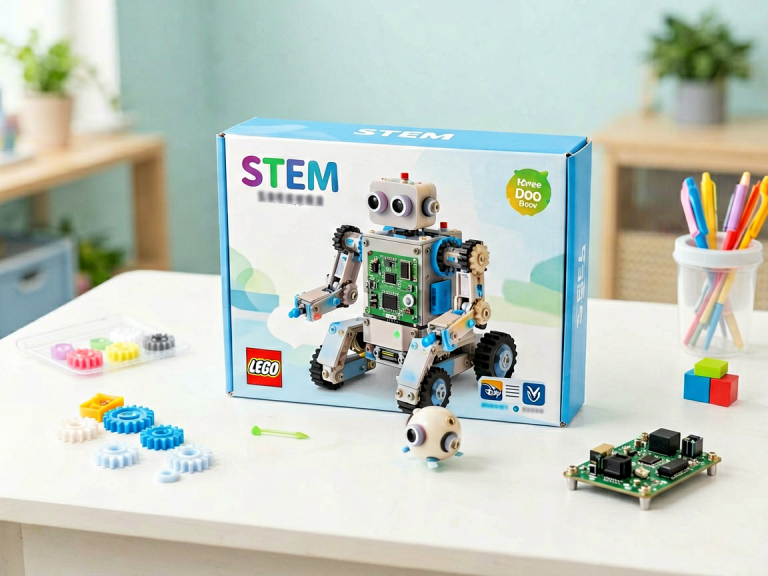
The preschool and early elementary years are a golden window for introducing the principles of logic, sequencing, and creativity through robot toys. Children aged four to seven are developing language skills, improving fine motor control, and beginning to understand rules and patterns. They are also highly imaginative, often treating toys as characters in elaborate stories. At this stage, the ideal robot toy should balance hands-on construction with intuitive programming. A prime example is the LEGO Education SPIKE Essential set, which combines colorful LEGO bricks with simple sensors and motors. Children can build a messenger robot or a dancing partner, then program its movements using a drag-and-drop block coding interface on a tablet. The visual nature of block-based coding aligns perfectly with the pre-reading stage; many children can “write” a program before they can read words. Another excellent option is “Botley 2.0,” a screen-free robot that children direct using a remote programer with arrow keys and repeated commands. Botley teaches sequencing, loops, and conditionals without any screen time, appealing to parents concerned about digital overload. Similarly, “Code-a-Pillar” from Fisher-Price allows children to connect segments that each represent a specific movement, creating a physical code chain. Such toys encourage trial-and-error problem solving in a low-stakes environment. Safety-wise, toys for this age group may include small components, so adult supervision is recommended, but the parts are typically large enough to be safe. Batteries should still be secured. Importantly, robot toys for four- to seven-year-olds should not require reading complex instructions. Instead, they should offer immediate, visible feedback: the robot moves forward when the child presses the correct sequence. This instant gratification builds confidence. Parents can enhance the experience by engaging in collaborative play—co-building a robot body or asking the child to predict what the robot will do next. Studies show that early exposure to coding-like activities in a playful context improves later performance in mathematics and spatial reasoning. Therefore, investing in a quality robot toy at this stage is not just about fun; it is an investment in cognitive development. However, avoid toys that demand lengthy setup or have steep learning curves, as they may overwhelm young children. Keep the focus on exploration and narrative: “Let’s make our robot deliver a message to your dollhouse!”
Robot Toys for Ages 8–12: Intermediate Coding and Customization
As children enter the middle school years, their capacity for abstract thinking, sustained focus, and complex problem-solving expands dramatically. For ages eight to twelve, robot toys can move beyond basic commands and into more sophisticated programming languages, customization, and interdisciplinary projects. At this stage, children are not just users but creators; they want to build a robot that reflects their personality and accomplishes specific tasks. One of the most popular platforms in this age group is LEGO Mindstorms Robot Inventor, which allows kids to build five distinct robot models—from a robotic snake to a humanoid—and program them using Scratch-based coding or, for more advanced users, Python. The kit includes sensors like color, distance, and gyro, enabling robots to react to their environment. Another strong contender is the “Makeblock mBot,” a low-cost robotics kit that teaches electronics and programming. The mBot can be controlled via a smartphone app or a laptop, and children can expand it by adding LED matrices, voice modules, or servos. For those interested in artificial intelligence, “Cozmo” by Anki (now owned by Digital Dream Labs) offers a pocket-sized robot that uses computer vision to recognize faces, express emotions, and play games. Cozmo can be programmed with a visual coding interface, and its personality-like behavior fosters emotional engagement. Safety considerations for this age group are less about choking hazards and more about digital citizenship and screen time management. Many advanced robot toys require tablets or computers, so parents should set limits and discuss online safety, especially if the toy has companion apps that connect to the internet. Additionally, some kits involve soldering or small screws; while eight-year-olds may handle these with supervision, parents should assess their child’s fine motor skills and patience. The educational benefits are substantial: children learn debugging (finding and fixing errors in code), geometric reasoning (when programming angles for movement), and design thinking (iterating on a robot’s form). Many schools use these toys as part of their STEM curriculum, and competitions like First LEGO League offer a competitive but collaborative environment. Home use should encourage creativity—for example, challenge your child to program a robot to navigate a homemade maze, or to follow a black line drawn on paper. The key is to provide a scaffold of support while allowing the child to struggle productively. At this age, a robot toy can become a springboard for lifelong interests in engineering, computer science, or robotics.
Robot Toys for Teens and Beyond: Advanced Robotics and AI
Teenagers and young adults (ages thirteen and up) are ready for robot toys that mirror real-world engineering challenges. At this level, the line between “toy” and “educational tool” blurs, as these devices often incorporate professional-grade components, programming languages, and open-source platforms. The primary goal shifts from learning basics to applying knowledge in creative, autonomous projects. One standout product is the “Rover” from SparkFun or the “Romibo” robot, which require assembly, wiring, and coding in Python or C++. These kits often feature Raspberry Pi or Arduino microcontrollers, allowing teens to interface with sensors like cameras, ultrasonic rangefinders, and accelerometers. For those interested in humanoid robotics, the “NAO” robot (though expensive) offers a fully programmable platform used in research labs, while the more affordable “STPD” series from UBTECH provides realistic motion and voice capabilities. Another popular option is “VEX Robotics” kits, which are used in high school competitions; building a VEX robot involves metal framing, gears, motors, and a Cortex or V5 brain. Teens can program these robots using a text-based language, learning about proportional control, feedback loops, and memory management. Safety for this age group is less physical and more about responsible use of hardware (e.g., handling lithium batteries properly, avoiding short circuits) and data privacy (e.g., if the robot has a camera, ensuring it is not used to record without consent). Parents should also be aware that some advanced robots can be used for surveillance or autonomous navigation, which raises ethical questions; discussing these with a teenager enhances their critical thinking. The developmental benefits are profound: teens develop systems thinking, project management (designing, building, testing, and iterating), and resilience in the face of failure. Many go on to pursue engineering degrees or compete in robotics olympiads. However, it is important to match the robot to the teen’s interests. A teenager fascinated by artificial intelligence might prefer a voice assistant robot like “Jibo” (now discontinued but still interesting) or a DIY AI kit; one interested in mechanical design may love a robot arm kit. Finally, for college-bound students, robot toys can double as portfolio pieces for applications. The key is to embrace open-ended play—an advanced robot may take weeks to build and program, but the sense of accomplishment is unparalleled.
Conclusion: Matching the Robot to the Child
Selecting the right robot toy is not a one-size-fits-all decision. The age recommendations on the box provide a useful guide, but they must be balanced with awareness of the individual child’s temperament, previous experience, and innate interests. A seven-year-old who has been building with LEGO for years might be ready for a Mindstorms set, while a ten-year-old who prefers storytelling might enjoy a more narrative-driven robot. Additionally, parents should consider the practical context: available time for assembly, presence of siblings to share the toy, and the family’s screen-time philosophy. Robot toys are unique in their ability to blend play, learning, and technology. When chosen appropriately, they can demystify coding, spark a passion for innovation, and build confidence in problem-solving. They also teach patience and perseverance—virtues that transcend any single toy. Conversely, a poorly chosen robot toy can become a dusty shelf occupant. Therefore, before purchasing, research reviews, watch demonstration videos, and if possible, let the child try a demo at a store or library. Remember that the best robot toy is not necessarily the most expensive or feature-packed; it is the one that fits the child’s current abilities and encourages them to reach just a little further. Whether your child is a toddler mesmerized by a blinking light or a teenager debugging a line of Python code, the journey of robotics is a lifelong adventure. By respecting age recommendations while remaining flexible to your child’s unique development, you can ensure that the robot toy becomes a cherished companion in learning—and in fun.