Introduction: Why Open-Ended Toys Matter
Title: The Ultimate Guide to the Best Open-Ended Toys for Kids: Fostering Creativity, Problem-Solving, and Lifelong Learning
In a world saturated with flashing lights, preset scripts, and single-purpose gadgets, parents and educators are increasingly turning back to the classics—toys that don’t tell a child what to do, but instead invite them to imagine, build, and explore. These are open-ended toys: playthings without a fixed outcome, no instruction manual, and no “right” way to play. From a set of simple wooden blocks to a box of art supplies, open-ended toys empower children to become the architects of their own worlds. They are not just toys; they are tools for cognitive development, emotional regulation, and social collaboration.
Research in child development consistently underscores the value of unstructured play. According to the American Academy of Pediatrics, play is essential for building executive function skills, such as self-regulation, flexible thinking, and planning. Open-ended toys are the perfect vehicle for this kind of play because they require children to make decisions, solve problems, and invent narratives. Unlike electronic toys that beep and flash in predictable patterns, open-ended materials respond only to the child’s imagination—making every play session unique.
This article explores the best open-ended toys for children across different ages and developmental stages. Each category has been selected not just for its popularity, but for its proven ability to spark creativity, encourage persistence, and grow with the child. We will also discuss practical tips for choosing and using these toys effectively, so you can build a playroom that nurtures rather than distracts.
The Anatomy of an Open-Ended Toy: What Makes It Exceptional?
Before diving into specific recommendations, it’s helpful to understand the criteria that define a truly great open-ended toy. Not every “simple” toy qualifies. The best open-ended toys share several key characteristics:
- No prescribed outcome: The toy does not come with a pre-designed goal. A puzzle, for example, is not open-ended because the only successful outcome is fitting the pieces correctly. A set of wooden blocks, on the other hand, can become a castle, a spaceship, or a farm.
- Adaptability across ages: A high-quality open-ended toy can be used in different ways as a child grows. A toddler might stack blocks; a preschooler might use them to create patterns; an older child might incorporate them into complex engineering projects.
- Encouragement of multiple skills: These toys naturally combine fine motor skills, spatial reasoning, language development, and social interaction when played with others.
- Durability and safety: Since open-ended toys are often handled roughly, stuffed into bags, and dropped, they should be made of safe, non-toxic materials that withstand years of use.
With these criteria in mind, let’s explore the best options available.
1. The Timeless Power of Building Blocks
Wooden blocks are the quintessential open-ended toy. Simple, natural, and endlessly versatile, they have been a staple of childhood for centuries—and for good reason. A basic set of unit blocks, such as those made by companies like Hape, Melissa & Doug, or Guidecraft, can provide years of educational play.
Why they work: Blocks teach children about gravity, balance, symmetry, and geometry. When a child builds a tower that wobbles and falls, they learn cause and effect. When they try again and add support pillars, they practice problem-solving. Blocks also encourage collaboration: two children building a city must negotiate space and share ideas.
Age range: Starting around 12–18 months, children enjoy knocking down towers. By age 2–3, they begin stacking. By 4–5, they create elaborate structures with arches, bridges, and rooms. Even 7- and 8-year-olds will use blocks for complex architectural projects.
What to look for: Choose sets with a variety of shapes (rectangles, squares, triangles, cylinders) and sizes. Natural, unpainted wood is preferable because it allows the child’s imagination to assign color and meaning. Avoid blocks with pre-printed letters or numbers—they limit open-endedness.
2. Magnetic Tiles: A Modern Marvel
Magnetic building tiles, such as Magna-Tiles, PicassoTiles, or Connetix, have become phenomenally popular—and for good reason. These translucent plastic shapes with embedded magnets snap together easily, allowing children to build 2D patterns and 3D structures with minimal frustration.
Why they work: Unlike traditional blocks, magnetic tiles don’t require perfect alignment or balancing. The magnets hold everything together, so even young children can build tall towers and complex geometric forms. This reduces frustration and builds confidence. The tiles also appeal to visual-spatial learners: children can create symmetrical designs, explore light and color by holding them up to a window, and even use them for early math concepts like fractions and area.
Age range: Suitable from around age 3 and up (due to small magnet safety concerns). They remain engaging through elementary school—older kids can build geodesic domes, castles with multiple rooms, and moving mechanisms.
Pro tip: Combine magnetic tiles with small figurines or loose parts (like pom-poms or bottle caps) to extend play. A child might build a house and then decorate it with a tiny toy animal inside.
3. Loose Parts Collections: The Un-Toy
The term “loose parts” was coined by architect Simon Nicholson, who argued that creativity thrives when children have access to a variety of materials they can move, combine, and transform. A loose parts collection might include wooden rings, fabric scraps, pinecones, corks, bottle caps, string, buttons, and natural stones. These items have no inherent purpose—their value lies entirely in what a child chooses to do with them.
Why they work: Loose parts encourage divergent thinking. A child can use a wooden ring as a bracelet, a wheel for a toy car, a base for a tiny tower, or a stamp in play dough. This type of play strengthens cognitive flexibility and symbolic thinking—the ability to use one object to represent another, which is foundational for reading and math.
Age range: Even babies can explore loose parts with supervision (avoid choking hazards). Toddlers love sorting, stacking, and filling containers. Preschoolers use them for pretend play (a cork becomes a cup of tea). Older children create elaborate small-world scenes or incorporate them into art projects.
How to start: Gather a small bin of natural and recycled items. Rotate the collection every few weeks to keep it fresh. Include items of different textures, sizes, and weights. Do not include instructions—let the child decide.
4. Art and Craft Supplies: The Ultimate Canvas
Art supplies are perhaps the most open-ended toy category of all. A box of crayons, a stack of paper, some glue, and scissors can yield a thousand different creations. But to truly maximize open-ended potential, consider offering unstructured art materials rather than coloring books or paint-by-numbers.
Why they work: Art allows children to express emotions, experiment with colors and shapes, and develop fine motor control. When there is no predetermined outcome, children learn to take creative risks. They also develop persistence: a child who is frustrated that a drawing “doesn’t look right” can learn to adapt and try again.
Recommended materials:
- Washable watercolor paints and brushes
- Play dough (homemade or store-bought) with simple tools like cookie cutters, rolling pins, and plastic knives
- Modeling clay (air-dry or polymer, depending on age)
- Collage materials: old magazines, tissue paper, yarn, feathers, googly eyes
- Markers and crayons (prefer larger, ergonomic shapes for younger children)
Age range: From 12 months with supervised non-toxic crayons, through teens who may enjoy advanced techniques like paper mâché or jewelry making.
Important note: Avoid kits that tell children exactly what to make. Instead, provide a “menu” of materials and let the child lead. Ask open-ended questions: “What would you like to create today?” or “Can you tell me about your picture?”
5. Dollhouses and Miniature Worlds
A dollhouse is not just a toy—it’s a stage for storytelling. Whether it’s a traditional wooden house or a simple set of small furniture and figurines, miniature worlds allow children to reenact daily life, explore social roles, and process emotions.
Why they work: Pretend play with dolls and houses promotes empathy, language development, and narrative skills. A child who places a doll in a bed and covers it with a tiny blanket is practicing caregiving. One who makes the dolls argue and then apologize is working through social conflict. Miniature worlds also invite endless customization: the furniture can be rearranged; the family can change; the house can become a castle or a spaceship.
Age range: Suitable from around 2–3 years old (with large, non-choking pieces). Older children (6–10) may enjoy more detailed miniatures, such as a school, a farm, or a castle. The play evolves as the child’s understanding of the world grows.
Tip: You don’t need an expensive store-bought dollhouse. A simple wooden shelf or cardboard box with drawn windows can become a house. Small wooden pegs painted as people, tiny felt blankets, and bottle-cap tables work perfectly.
6. Wooden Train Tracks and Road Sets
Wooden train tracks (like Brio or Thomas & Friends) or wooden road sets are classic open-ended toys that combine construction and narrative. Children lay out the tracks, decide where the bridges and tunnels go, and then run the trains along their creation. The track layout can be changed every time, creating a new geography.
Why they work: This type of play develops spatial planning, sequencing, and logical thinking. A child must figure out how to connect two ends of a track, or how to avoid a dead end. It also encourages patience and trial-and-error: a train might derail at a sharp curve, prompting the child to redesign the layout. Like blocks, train sets are collaborative—two children can build a sprawling railway together.
Age range: Starting around age 2 with simple oval tracks, and continuing up to age 7 or 8 with complex loops, switches, and elevated bridges.
What to look for: Choose sets that are compatible with standard wooden railway dimensions (Brio-compatible). Avoid sets that only allow one fixed configuration. Look for expansion packs that add curves, crossings, and accessories like trees and buildings.
7. Sensory Play Materials: Sand, Water, and Dough
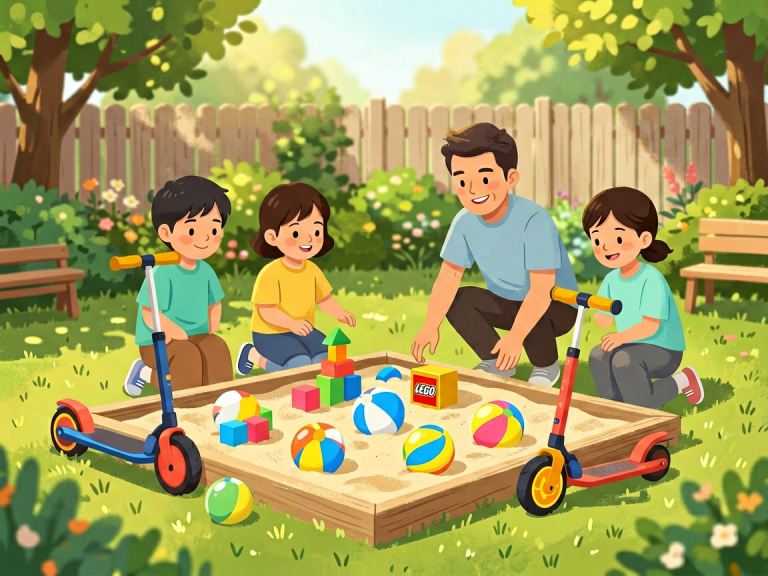
Sensory play is often messy, but it is one of the most beneficial forms of open-ended play. Sand tables, water tables, and play dough stations allow children to explore texture, volume, and cause and effect. They can dig, pour, squeeze, and mold without any predetermined goal.
Why they work: Sensory play is calming and regulating—it helps children focus and process sensory input. It also supports scientific thinking: a child who pours water from a small cup into a large bowl is learning about volume. One who mixes sand and water to make a "mud cake" is experimenting with material properties. These activities are especially beneficial for children who are sensory seekers or avoiders.
Age range: From infancy (supervised) through early elementary. Older children can add tools like funnels, scoops, measuring cups, and small plastic animals.
How to set up: An inexpensive plastic storage bin with a lid can become an indoor sand table. Use clean play sand, rice, or dried beans. For water play, add food coloring and a few water-safe toys. Rotate materials to maintain interest.
8. Musical Instruments: The Original Open-Ended Sound
While some musical toys (like electronic keyboards with preset songs) are closed-ended, simple percussion instruments—drums, shakers, bells, xylophones—are wonderfully open-ended. Children can explore rhythm, volume, and timbre in their own way.
Why they work: Making music builds auditory discrimination, motor coordination, and emotional expression. A child who bangs a drum fast and loud is learning to release energy. One who gently taps a xylophone is exploring melody. Group music play encourages turn-taking and listening.
Age range: From 6 months with rattles and soft shakers, through age 5+ with more complex instruments like a child-size glockenspiel.
Recommendations: Look for a set that includes a drum, a tambourine, maracas, and a triangle. Avoid electronic instruments that play pre-recorded songs. Real instruments (even toy-quality) give purer sound.
How to Choose the Right Open-Ended Toys for Your Child
With so many options, how do you decide? The key is to observe your child’s natural interests. A child who loves building and engineering might thrive with blocks and magnetic tiles. A child who loves storytelling might prefer a dollhouse or small-world figures. A child who is very active might engage best with a sand table or large building materials.
It is also important to consider quality over quantity. A small collection of well-made, versatile toys is far more valuable than a closet full of single-purpose plastic gadgets. Rotate toys periodically to keep them fresh—store some away and bring them out after a month.
Finally, remember that the toy itself is only half the equation. The most powerful open-ended play happens when adults step back and allow children to take the lead. Resist the urge to “correct” or “improve” their creations. Instead, ask questions, marvel at their ideas, and let them know that their imagination is the most valuable toy of all.
Conclusion: Invest in Play That Lasts
Open-ended toys are not a trend—they are a return to the fundamental principles of childhood development. They respect the child’s agency, nurture their innate curiosity, and provide a safe space for failure and experimentation. In a world that often values speed and productivity, these toys remind us that the slow, messy, unhurried process of play is itself the most important work of childhood.
By choosing building blocks over battery-powered robots, and loose parts over video games, we give our children the tools to become creative thinkers, resilient problem-solvers, and empathetic collaborators. And that is the best gift we can give.
*Word count: approximately 1,350 words (excluding title and subheadings)*