Unlocking Early Brilliance: The Best STEM Toys for 4-Year-Olds to Spark a Lifelong Love of Learning
Introduction
At the age of four, children are natural explorers. Their brains are like sponges, absorbing information at an astonishing rate, and their curiosity about the world around them is boundless. This is the golden window for introducing STEM—science, technology, engineering, and mathematics—concepts in a playful, hands‑on way. The best STEM toys for 4‑year‑olds do not feel like lessons; they feel like adventures. They transform abstract ideas into tangible experiences, allowing children to build, test, fail, and try again—all while laughing and learning.
In this article, we will explore why STEM toys are crucial at this developmental stage, break down the key categories of toys that work well for preschoolers, and provide detailed recommendations. By the end, you will have a clear, research‑backed guide to choosing toys that nurture your child’s growing mind without overwhelming them. Let’s dive in.
—
Why STEM Toys Matter at Age Four
The preschool brain is wired for cause‑and‑effect reasoning, pattern recognition, and imaginative play. Traditional toys like stuffed animals and dolls have their place, but STEM toys add an extra layer: they intentionally introduce problem‑solving, spatial reasoning, and early logic. A 4‑year‑old who plays with a simple magnetic building set is not just stacking blocks—they are experimenting with polarity, balance, and geometry. A child who uses a beginner coding robot is learning sequencing and debugging, skills that are foundational for computational thinking.
Moreover, the best STEM toys for this age group are designed to be open‑ended. They allow multiple solutions, which builds resilience. When a tower falls or a robot doesn’t move as expected, a child learns that failure is a stepping stone, not an end. This growth mindset, established early, is arguably more valuable than any specific fact. Research from the National Association for the Education of Young Children (NAEYC) emphasizes that hands‑on, inquiry‑based play leads to deeper understanding and longer retention. For 4‑year‑olds, this means they develop confidence in their ability to figure things out—a gift that lasts a lifetime.
—
Key Categories of STEM Toys for Preschoolers
Not all STEM toys are created equal. The best ones for 4‑year‑olds share several characteristics: they are safe (no small parts that pose choking hazards), they are visually engaging, and they require active participation rather than passive observation. Below, we break down the most effective categories, each targeting a different pillar of STEM.
1. Building and Construction Toys
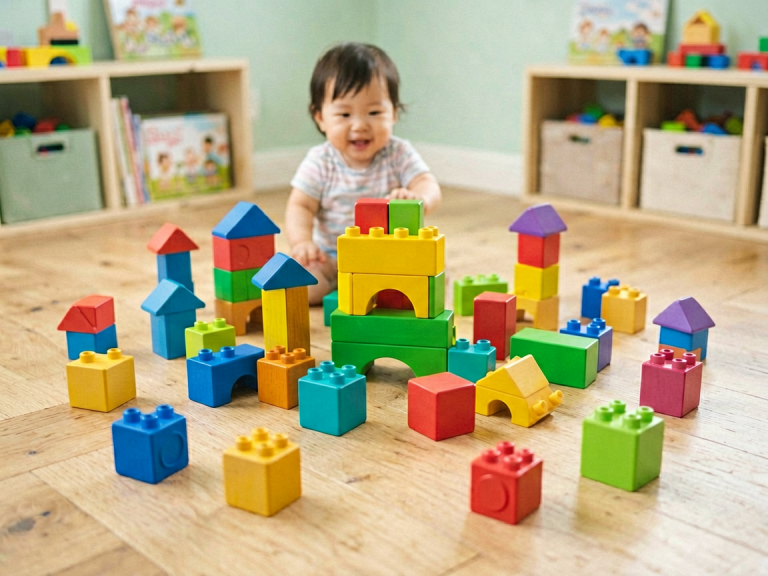
Building toys are the quintessential engineering tool for young children. They teach spatial awareness, balance, and structural integrity. For 4‑year‑olds, the ideal building sets have large, easy‑to‑handle pieces that snap together firmly but can be pulled apart without frustration.
Top picks:
- LEGO Duplo: These oversized blocks are perfect for little hands. Sets like the LEGO Duplo Steam Train or the LEGO Duplo Town 3‑in‑1 Tree House introduce cause‑and‑effect (e.g., the train moves when you push it) and simple mechanics. Children can follow the pictorial instructions or free‑build, both of which develop fine motor skills and planning.
- Magna‑Tiles: These translucent magnetic tiles are a classroom favorite. Their strong magnets allow children to build 3D structures—houses, rockets, castles—that defy gravity. The tiles also come in different shapes (squares, triangles, rectangles), subtly teaching geometry. A child who builds a cube learns that six squares can form a closed shape, an early geometry concept.
- Plus‑Plus Blocks: These simple, tube‑like blocks interlock in any direction, encouraging creativity. They are great for creating flat mosaics or 3D sculptures. Plus‑Plus is especially good for children who enjoy pattern‑making, a precursor to algebraic thinking.
2. Coding and Logic Games
Coding for a 4‑year‑old is not about screens or syntax; it’s about sequencing, pattern recognition, and directional thinking. The best toys in this category are screen‑free, tactile, and designed for cooperative play.
Top picks:
- Cubetto by Primo Toys: This little wooden robot is controlled by placing colored blocks into a board. Each block represents a command—forward, left, right, or function. As children arrange the blocks in sequence, Cubetto moves accordingly. It’s brilliantly simple: no batteries, no screens, just pure logic. A child who gets Cubetto to navigate a maze learns that order matters—a foundational concept for coding.
- Botley 2.0 the Coding Robot: Unlike Cubetto, Botley uses a remote programmer with buttons. Children input a sequence of directional commands (e.g., forward, turn left, move backward), then press “Go” to watch Botley roll around. It includes obstacles and “black line” following, which adds layers of challenge. Botley is highly durable, and its cheerful design keeps kids engaged for long stretches.
- ThinkFun Roll & Play: While not a coding robot, this game introduces logical thinking through simple action cards and a dice. Children roll the dice, pick the matching color card, and perform the action (e.g., “Make a happy face”). It’s deceptively educational—it teaches organization and following rules, both part of algorithmic thinking.
3. Science Exploration Kits
Science for preschoolers should be messy, sensory, and full of wonder. Simple experiments that involve mixing, measuring, and observing are ideal. The key is to choose kits that come with large, safe materials and clear, picture‑based instructions.
Top picks:
- Learning Resources Primary Science Lab Set: This set includes beakers, test tubes, a magnifying glass, and a pair of tweezers, all made from durable plastic. Parents can use food coloring and water to teach about color mixing, or vinegar and baking soda for a fizzy volcano. The set encourages hands‑on exploration without requiring complex explanations.
- NATIONAL GEOGRAPHIC Mega Science Kit for Kids (Earth Science version): While many components are for older kids, the “grow your own crystal” activity and the digging block with fossils are perfect for 4‑year‑olds with adult supervision. The thrill of uncovering a “real” fossil builds patience and fine motor control. The kit also includes a rock tumbler that can be used later, but the crystal growing alone is a mesmerizing lesson in chemistry.
- KiwiCo Koala Crate (ages 3–4): This monthly subscription delivers a complete science or art project. Past crates have included a pulley system, a color‑mixing lab, and a light‑up constellation project. Each crate comes with a magazine that explains the concept in simple language. The projects are designed to be completed in about 30 minutes, which is the perfect attention span for a 4‑year‑old.
4. Math and Counting Toys
Math at age four is all about number sense, counting, sorting, and comparing quantities. The best toys make numbers physical and give children something to count, group, and measure.
Top picks:
- Melissa & Doug Pattern Blocks and Boards: This classic set includes wooden shapes (triangles, rhombuses, hexagons) and boards with pattern outlines. Children place the shapes to complete the pictures, which requires them to match shapes and colors. It also teaches part‑whole relationships: a hexagon can be made from two trapezoids or six triangles. This is a precursor to fractions.
- Counting Bears by Learning Resources: These colorful plastic bears come in six colors and three sizes, along with sorting bowls and cups. Activities include sorting by color, counting bears into cups, and making patterns (e.g., red‑blue‑red‑blue). The bears are also great for introducing addition and subtraction in a concrete way: “You have three bears. I give you two more. How many now?”
- SMath by Snap Circuits? Not exactly—there is a game called “Smath” but for 4‑year‑olds, a better choice is Zingo! Number Bingo by ThinkFun. This fast‑paced number‑recognition game uses a tile dispenser that shoots out number tiles. Children match the tiles to their bingo card. It builds number identification and quick counting in a fun, social context.
- Wooden Number Puzzle Boards: Simple puzzles where numbers 1–10 fit into corresponding holes. Many versions include the same number of dots or objects below the number, so children can count them. This reinforces one‑to‑one correspondence, a critical early math skill.
—
How to Choose the Right STEM Toy for Your 4‑Year‑Old
With so many options, it’s easy to feel overwhelmed. Here are five guiding principles to ensure you select a toy that will truly benefit your child.
1. Prioritize open‑endedness. Toys that have only one correct answer—like a puzzle with a fixed solution—are fine in moderation, but the best STEM toys can be played with in many ways. A set of magnetic tiles can become a castle, a robot, a car, or a zoo. Open‑ended toys encourage divergent thinking and longer engagement.
2. Check for safety and age recommendations. Always look for the ASTM or CE safety mark. For 4‑year‑olds, avoid toys with small parts that could be swallowed. Brands like LEGO Duplo, Magna‑Tiles, and Learning Resources are known for rigorous safety testing.
3. Match the toy to your child’s current interests. If your child loves animals, a STEM toy that involves building animal habitats (like a tree‑house set) will be more engaging than a generic building set. If your child is fascinated by vehicles, look for coding robots or car‑themed construction kits.
4. Look for toys that involve parent or sibling interaction. While independent play is valuable, 4‑year‑olds benefit greatly from guided exploration. Toys like the Primary Science Lab Set or the KiwiCo crate are designed with adult‑child collaboration in mind. Playing together allows you to ask questions like “What do you think will happen if we add more water?” which deepens the learning.
5. Avoid toys that rely heavily on screens. Many so‑called “STEM apps” exist, but true hands‑on manipulation of physical objects is far more beneficial for 4‑year‑olds. The tactile feedback, the need to coordinate hand and eye, and the real‑world consequences of physical failure (the block falls, the robot stops) are irreplaceable.
—
Conclusion: Planting Seeds for Future Innovators
The best STEM toys for 4‑year‑olds are not expensive gadgets or complicated kits. They are simple, well‑designed tools that invite curiosity, allow failure, and celebrate discovery. A child who builds a wobbly tower with Magna‑Tiles and then figures out how to stabilize it has just practiced engineering iteration. A child who programs Cubetto to reach a treasure chest has internalized sequencing and debugging. A child who mixes blue and yellow paint to make green has conducted a chemistry experiment.
These moments are small, but they accumulate. They build a child’s confidence in their own ability to understand and shape the world. As parents, educators, and caregivers, our role is not to “teach” STEM but to provide the environment where it can unfold naturally. By choosing toys that are developmentally appropriate, open‑ended, and joy‑filled, we give our children the best possible start—not just in academics, but in a lifelong love of learning.
So go ahead: clear a space on the floor, sit down with your little one, and start stacking, coding, and mixing. The future you are building together begins with that simple, beautiful act of play.