The Ultimate Guide to the Best Educational Toys for 4-Year-Olds
The fourth year of life is a whirlwind of cognitive leaps, linguistic explosions, and burgeoning social awareness. A four-year-old is no longer a toddler but a fully fledged preschooler, eager to ask “why,” to negotiate with peers, and to test the limits of their own physical abilities. This is the golden age for educational toys—tools that channel this boundless energy into meaningful learning without ever feeling like a lesson. The right toy at this stage does not merely entertain; it scaffolds development in areas as diverse as fine motor control, early math reasoning, emotional regulation, and creative problem-solving. Yet with an overwhelming market flooded with flashing lights and empty promises, parents and caregivers need a discerning guide. This article explores the very best educational toys for four-year-olds, organized by developmental domain, and explains why each selection earns its place in a child’s playroom.
Why Age 4 is a Critical Developmental Stage
Understanding why specific toys matter at this age requires a look at the developmental milestones that define a four-year-old. Cognitive growth accelerates dramatically: children begin to grasp cause and effect, sort objects by multiple attributes (color, shape, size), and engage in simple symbolic play that mirrors real-world scenarios. Their vocabulary typically swells to over 1,500 words, and they start to construct sentences of five or more words. Socially, parallel play gives way to cooperative play, where sharing, turn-taking, and negotiating become daily challenges. Emotionally, they experience a wider range of feelings but still struggle to name and manage them. Physically, they refine their pincer grip for writing, develop balance for hopping and skipping, and gain the stamina for prolonged active play. Educational toys that target these specific capacities can turn playtime into a powerful developmental intervention. A toy that encourages pattern recognition, for instance, strengthens neural pathways that later support reading and mathematics. A collaborative game teaches conflict resolution far more effectively than a lecture. Therefore, choosing a toy is not a trivial decision—it is an investment in the architecture of a young mind.
Categories of Educational Toys for 4-Year-Olds
Rather than offering a random list, it is helpful to group educational toys by the primary skill they develop. While most high-quality toys support multiple areas, understanding the categories helps parents balance a child’s play diet. The five essential categories for a four-year-old are: STEM (science, technology, engineering, and mathematics) toys that foster logical reasoning; creative and imaginative toys that fuel self-expression and narrative thinking; language and literacy toys that expand vocabulary and pre-reading skills; social-emotional toys that build empathy and cooperation; and physical play toys that strengthen gross and fine motor abilities. The best educational toys for this age often blend two or three categories—for example, a magnetic building set that requires counting (STEM) while also allowing a child to construct a castle (creativity) and collaborate with a sibling (social). The following sections highlight standout examples within each category, chosen for their durability, open-endedness, and proven capacity to engage a four-year-old's natural curiosity.
Top Picks for STEM Learning
STEM toys for four-year-olds should be concrete, hands-on, and rooted in play rather than abstract theory. One of the most versatile options is a set of magnetic tiles, such as Magna-Tiles or Picasso Tiles. These translucent, geometric shapes snap together with magnets, allowing children to build 3D structures, explore symmetry, and experiment with balance and gravity. A four-year-old can spend an hour stacking a tower, only to delight in its crash, learning about structural integrity through trial and error. Another exceptional STEM toy is the “Learning Resources Coding Critters,” a screen-free coding toy that uses simple directional cards to program a small animal robot to move through an obstacle course. This introduces sequencing, logical steps, and debugging in a playful context. For early math, nothing beats a set of counting bears with sorting cups, tweezers, and activity cards. These allow children to practice one-to-one correspondence, color sorting, and even simple addition as they “feed” bears into a numbered cave. Finally, a simple wood balance scale—like the one from Hape—turns weighing rocks, toy fruits, or blocks into a lesson about comparison, estimation, and mass. Each of these toys demands active participation, not passive observation, which is the hallmark of effective STEM education at this age.
Fostering Creativity and Imagination
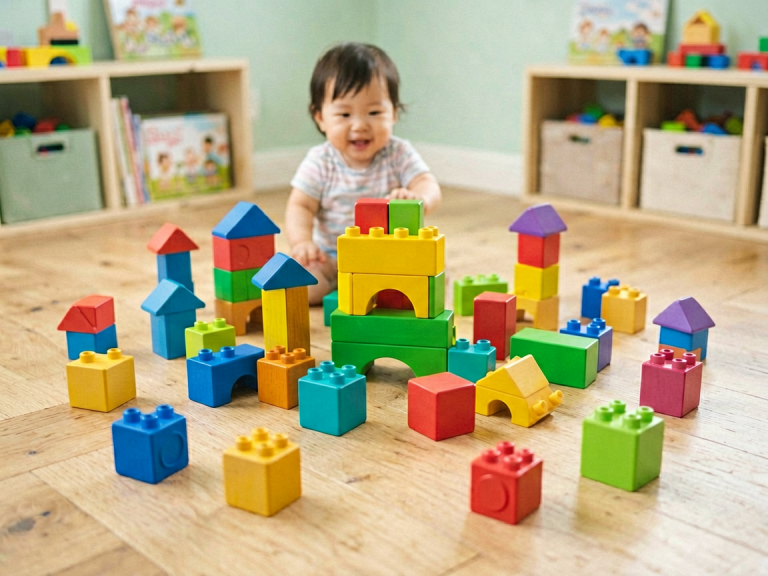
Creativity at age four is not about producing a finished masterpiece but about exploring materials, telling stories, and inhabiting imaginary worlds. The best creative toys are open-ended, meaning they have no fixed outcome. A high-quality set of wooden blocks, such as Unit Blocks from Melissa & Doug or the classic Kapla planks, offers infinite possibilities: a road, a castle, a spaceship, or a zoo. Unlike structured building sets that require following an instruction manual, these blocks put the child in charge of design. Equally powerful are art supplies that are messy but manageable. Watercolor sets with good-quality brushes, Crayola’s “Color Wonder” paper that only reveals color when used with special markers, and a large roll of butcher paper for floor drawing all invite self-expression without fear of mistakes. For dramatic play, a play kitchen with realistic utensils or a doctor’s kit with a stethoscope and bandages allows a child to process real-life experiences, from cooking to visiting the pediatrician. A particularly innovative creative toy is “Stomp Rocket,” where a child jumps on an air bladder to launch a foam rocket. This combines physical action with cause-and-effect reasoning and narrative—every launch becomes a mission to the moon. These toys do not tell the child what to do; they ask, “What will you create?”
Language and Literacy Development
At four, many children are on the cusp of reading, but the emphasis should remain on oral language, phonological awareness, and a love of stories rather than forced decoding. The best language toys make words and sounds irresistibly fun. A set of alphabet magnets with a magnetic board, for instance, lets children arrange letters, spell their own names, and match uppercase to lowercase. Look for magnets that include both cases and that are large enough to prevent choking hazards. Another standout is the “Zingo!” game by ThinkFun, a bingo-style game that uses picture-and-word tiles. As the child slides the machine, they see a picture (e.g., a cat) and must find the matching word on their card. This builds sight-word recognition and vocabulary in a fast-paced, social setting. For storytelling, a set of “Story Cubes” (nine dice with different pictures on each face) is brilliant: a child rolls the dice and must invent a story that incorporates all the images shown. This develops narrative sequencing, imagination, and verbal expression. Additionally, “LeapFrog’s Tad’s Fridge Phonics” turns the kitchen into a letter-learning zone, with songs that reinforce letter sounds. Finally, don’t underestimate classic picture books with rich vocabulary. But to enhance interaction, use a set of “felt storyboards” where children can move characters as you read—this transforms passive listening into active participation. These toys make language a playground, not a chore.
Social and Emotional Growth Through Play
The preschool years are when friendships become more complex, and children must learn to manage disappointment, share, and express feelings constructively. Educational toys designed for social-emotional learning (SEL) can be subtle yet powerful. Cooperative board games—where all players work together against a common goal rather than competing against each other—are excellent. “Hoot Owl Hoot!” by Peaceable Kingdom is a classic example: players help owls fly back to their nest before the sun rises. There is no single loser, so children learn teamwork and how to handle setbacks as a group. Another superb SEL toy is the “Feelings Flashcards” from “The Zones of Regulation” or similar sets, paired with a plush doll. A caregiver can ask, “How does the puppet feel today? Can you find the card that shows that feeling?” This helps children label their own emotions and develop empathy. For conflict resolution practice, a set of “Bernese” or “Magna-Tiles” becomes a social tool when two children want the same tile—they learn to negotiate or take turns. Additionally, a simple “sand timer” (e.g., a 3-minute hourglass) used in turn-taking games visually signals when it is time to switch, reducing arguments. Role-playing sets such as a “cash register” with play money also require social reciprocity: saying “please,” “thank you,” and negotiating prices. These toys teach that relationships are built on communication and cooperation, a lesson that will serve children for a lifetime.
Physical Development and Active Play
While many educational toys focus on the mind, the four-year-old body is equally hungry for movement. Gross motor skills—running, jumping, climbing, balancing—as well as fine motor skills like cutting, threading, and manipulating small objects—need deliberate practice. One of the best active toys for this age is a “balance bike” (a pedal-less bicycle that the child propels by walking and then gliding). Balance bikes vastly accelerate the learning of real cycling, but more importantly, they build core strength, coordination, and confidence. For indoor play, consider a “Montessori climbing triangle” with a ramp, which encourages climbing, sliding, and balancing in a safe, contained space. Another excellent choice is the “Lily & River Little Climber” or similar foam pad and climbing structure. For fine motor development, “lacing beads” with thick strings demand precise hand-eye coordination, which is a precursor to handwriting. “Wooden peg puzzles” with knobs help the pincer grasp. “Play-Doh” with tools (scissors, rolling pins, stamps) strengthens hand muscles while allowing creative expression. A “speedy” ball run kit—like a wooden marble run—requires careful building and then rewards with a satisfying kinetic display. Finally, outdoor toys such as a “skip ball” (a plastic ring with a ball attached to an ankle strap) teach rhythm and coordination. Physical play is not a break from learning; it is an integral part of brain development because movement stimulates the cerebellum and prefrontal cortex, improving attention and self-regulation.
How to Choose the Right Toy for Your Child
Despite this extensive list, the best educational toy for any individual four-year-old depends on that child’s personal interests, temperament, and current skill level. There are a few guiding principles. First, prioritize open-ended toys over rigid, single-purpose gadgets. A toy that can be used in ten different ways will outlast a toy that only makes a specific sound or performs a specific function. Second, consider the child’s current passion. If a child is obsessed with dinosaurs, a dinosaur-themed counting game or a set of dinosaur figurines for small-world play will capture their attention far more effectively than a generic math toy. Third, look for toys that require active engagement—where the child creates, builds, or solves—rather than passive observation (e.g., electronic toys that “talk” too much). Fourth, don’t underestimate the value of toys that involve a parent or peer. The richest learning often happens through conversation and joint attention during play. Finally, safety is paramount: ensure that toys are made of non-toxic materials, have no small parts that could cause choking, and are sturdy enough to withstand enthusiastic use. By applying these filters, every purchase becomes a thoughtful contribution to the child’s developmental journey.
Conclusion
The best educational toys for four-year-olds are those that respect the child’s innate drive to learn through play. They do not lecture, but rather invite exploration; they do not dictate, but rather offer possibilities. From the magnetic tiles that build spatial reasoning to the balance bike that builds physical confidence, from the story cubes that ignite language to the cooperative games that teach empathy, each toy serves as a catalyst for growth. A four-year-old’s brain is forming neural connections at a rate that will never be repeated. Every moment of joyful, engaged play is a moment of wiring the brain for future success—not just in school, but in life. The toys we choose are the architects of that wiring. So when you select a simple set of wooden blocks or a pack of magnetic tiles, know that you are giving far more than a present. You are giving the gift of curiosity, resilience, and a lifelong love of learning. And that is the most educational toy of all.