The Power of Play: Why Screen-Free Toys Are Essential for 4-Year-Olds
Introduction: A Digital Dilemma
In an age where tablets and smartphones have become ubiquitous babysitters, parents of four-year-olds face a constant tug-of-war between convenience and developmental necessity. The average preschooler now spends nearly two hours per day in front of screens, according to recent studies, and this number climbs alarmingly fast. Yet child development experts increasingly warn that excessive screen time at this critical age can hinder language development, reduce attention spans, and limit opportunities for hands-on learning. The solution is not simply to ban screens, but to actively curate a rich environment of screen-free toys that engage a four-year-old’s natural curiosity, creativity, and need for physical interaction. This article explores the profound benefits of screen-free toys for four-year-olds, offers concrete categories of toys that support holistic development, and provides practical advice for parents seeking to reduce digital dependency without sacrificing entertainment value.
Why Screen-Free Toys Matter for Four-Year-Olds
The Developmental Landscape at Age Four
At four, children are in a remarkable stage of growth. Their language abilities explode, as they begin to construct complex sentences and ask endless “why” questions. Their fine motor skills improve rapidly, allowing them to draw shapes, use scissors, and manipulate small objects. Socially, they start to engage in cooperative play, negotiate with peers, and understand basic rules. Cognitively, they enter what Jean Piaget called the “preoperational stage,” characterized by symbolic thinking, pretend play, and an emerging ability to solve problems through trial and error.
Screen-based activities largely bypass these crucial developmental processes. A passive video may entertain, but it does not require a child to build, create, negotiate, or physically experiment. In contrast, screen-free toys demand active engagement. When a four-year-old stacks wooden blocks, they are not just playing—they are learning physics (balance, gravity), mathematics (symmetry, counting), and persistence. When they dress up as a doctor and treat a stuffed animal, they are practicing empathy, storytelling, and social roles. These are the building blocks of cognitive and emotional intelligence that screens simply cannot replicate.
The Risks of Premature Screen Dependence
The American Academy of Pediatrics recommends no more than one hour of high-quality screen time per day for children aged two to five, yet many families exceed this limit. Excessive screen exposure at age four has been linked to developmental delays in language, reduced ability to focus, and even behavioral issues. The rapid, high-reward nature of many apps and videos trains young brains to expect instant gratification, making it harder for them to engage in slower, more demanding activities like puzzles or imaginative play. Screen-free toys restore the natural rhythm of play: one that involves problem-solving, frustration tolerance, and the deep satisfaction of creating something with one’s own hands.
Top Categories of Screen-Free Toys for Four-Year-Olds
1. Construction and Building Toys: Engineering the Imagination
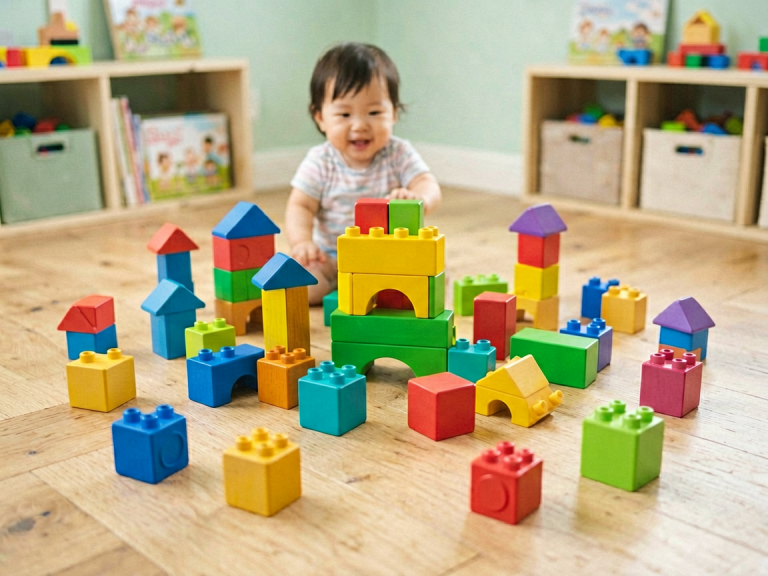
Building toys are perhaps the most versatile and developmentally rich category for a four-year-old. Classic unit blocks—simple, unpainted wooden blocks in various shapes—allow children to create towers, bridges, and entire cities. Unlike many modern electronic toys that prescribe a single correct way to play, blocks are infinitely open-ended. A child might spend thirty minutes constructing a castle, only to knock it down and rebuild a spaceship. This process teaches spatial reasoning, cause and effect, and the basics of structural engineering.
More specific building sets like magnetic tiles (e.g., Magna-Tiles) or interlocking plastic bricks (e.g., Duplo) add new dimensions. Magnetic tiles offer translucent colors and geometric shapes that encourage exploration of symmetry and light. Duplo blocks, larger than standard LEGO, are perfect for little hands and allow children to follow simple picture instructions or invent their own designs. Research shows that construction play correlates with improved math skills and executive function later in life. For a four-year-old, the best building toys are those that are sturdy, safe, and offer enough variety to sustain long periods of engagement.
2. Pretend Play and Role-Playing Sets: Building Social and Emotional Skills
Four-year-olds are natural storytellers. Their imagination is at a peak, and they love to imitate the adults around them. Screen-free toys that support role-playing are invaluable for social and emotional development. A simple wooden kitchen set with pots, pans, and play food invites a child to “cook” for their stuffed animals, mimicking daily routines and practicing language through dialogue. Similarly, doctor kits, tool benches, and cash registers allow children to step into different roles and negotiate between themselves and their peers. This type of play helps children understand adult world responsibilities, build vocabulary, and develop empathy by imagining how others feel.
Dress-up costumes are another essential component. A cape, a hat, a pair of fairy wings—these simple props transform a child into a superhero, a princess, or a firefighter. Unlike screen characters that are pre-defined, dress-up play allows the child to create their own narrative, complete with rules, conflicts, and resolutions. This fosters creativity, confidence, and the ability to collaborate with other children. Parents can support this by providing a box of old clothes, accessories, and neutral props like scarves and masks that can be repurposed in infinite ways.
3. Art and Craft Supplies: Expressing Without Limits
Four-year-olds are often ready for more advanced art materials beyond crayons and finger paints. Screen-free art toys such as watercolor sets, washable markers, modeling clay, safety scissors, and glue sticks offer endless possibilities for self-expression. Drawing and painting strengthen fine motor control, hand-eye coordination, and concentration. When a child decides what to draw and how to execute it, they are practicing planning and decision-making. Modeling clay, in particular, is excellent for developing hand strength and dexterity, which are essential for future writing.
Open-ended art kits—those that do not come with a specific project to copy—are far more valuable than pre-printed coloring books or craft kits with predetermined outcomes. Coloring books have their place, but they teach conformity rather than creativity. Instead, provide blank paper, a variety of tools, and simple prompts like “draw a monster living under your bed” or “make a sculpture of your favorite animal.” The process is more important than the product; a child who feels free to experiment will develop a lifelong love of making art.
4. Puzzle and Problem-Solving Games: Sharpening the Mind
Four-year-olds are increasingly capable of solving puzzles with 12 to 24 pieces. Jigsaw puzzles teach spatial awareness, pattern recognition, and patience. They also provide a satisfying sense of accomplishment when the last piece clicks into place. Beyond standard jigsaw puzzles, consider shape-sorters, simple matching games, and memory cards. These toys strengthen working memory and attention to detail.
Board games designed for preschoolers are another excellent screen-free option. Games like “Hoot Owl Hoot!” or “Count Your Chickens” teach turn-taking, following rules, and managing emotions when losing (or winning). Cooperative games, where players work together against the game itself, are particularly beneficial because they reduce competitiveness and foster collaboration. Avoid complex games with many small pieces; the best games for four-year-olds have clear rules, large components, and a short playing time of 10–15 minutes.
5. Outdoor and Active Play Toys: Moving Bodies, Growing Minds
Screen-free does not only mean quiet, indoor activities. Four-year-olds need physical activity to develop gross motor skills, coordination, and overall health. Simple outdoor toys like tricycles, balance bikes, balls, jump ropes, and sandbox sets provide essential opportunities for movement. Scooters (with three wheels for stability) and small climbing structures also build balance and muscle strength.
Outdoor play also encourages sensory exploration. A sandbox with shovels, buckets, and molds allows children to experiment with texture, volume, and gravity. Water tables, available for warm weather, add another dimension of scientific exploration—pouring, floating, sinking, and measuring. These activities are inherently screen-free and engage multiple senses simultaneously, which is crucial for brain development. Parents should aim for at least one hour of active, unstructured outdoor play daily.
How to Introduce and Sustain Screen-Free Play
Creating a Play-Friendly Environment
To successfully replace screen time with screen-free toys, parents must think deliberately about the play environment. First, designate a clear, accessible space for toys—preferably low shelves where children can see and reach their options. Rotate toys every few weeks to keep them fresh; a forgotten box of blocks can feel brand new after a month in storage. Avoid over-crowding: too many choices overwhelm a young child’s decision-making ability. Five or six well-chosen play options are far more effective than a bin of 50 mismatched toys.
Second, model screen-free behavior. Children learn by imitation. If they see parents scrolling on phones during play, they will naturally gravitate toward screens. Set aside specific times for “together play” where you engage with your child using their toys. Your participation—sitting on the floor, building a block tower, asking open-ended questions—validates the activity and strengthens your bond. Eventually, the child will learn to engage independently for longer stretches.
Balancing Screen and No-Screen Time
It is unrealistic and perhaps unnecessary to eliminate screens entirely. Educational programming and carefully chosen apps can supplement learning. However, the ratio should heavily favor screen-free play. A good guideline is to structure the day so that screen time occurs only after a child has had ample active, creative, and social play. For a four-year-old, that might mean 30 minutes of educational TV or an interactive app after a morning of building, pretending, and outdoor running. The key is to make screen time a reward, not the default activity.
Conclusion: Investing in the Tools of Childhood
The market is flooded with noisy, flashing, app-connected toys that promise to make children smarter, but the evidence is clear: the best toys for a four-year-old are often the simplest. A set of wooden blocks, a box of crayons, a tricycle, and a collection of costumes provide the raw materials for a childhood rich in discovery, creativity, and joy. Screen-free toys do more than entertain—they build the neural pathways, the social skills, and the emotional resilience that will serve a child for a lifetime.
As parents, the choice is not between technology and no technology. It is about creating a balanced childhood where hands-on play remains central. The next time you consider buying a toy for a four-year-old, ask yourself: Does this toy invite the child to act, or just to watch? Does it require imagination, or does it provide all the answers? Does it encourage interaction with people, or with a screen? The answers will guide you toward toys that truly empower a child to grow. In an increasingly digital world, the most valuable gift we can give a four-year-old is the freedom to play without a screen.