The Power of Building Toys for 2-Year-Olds: Nurturing Early Development Through Creative Play
Introduction: Why Building Toys Matter at Age 2
At the age of two, children are experiencing a remarkable explosion of cognitive, physical, and emotional growth. They are no longer passive infants but active explorers eager to touch, stack, knock down, and create. Building toys—simple blocks, soft stackers, magnetic tiles, or interlocking pieces—are among the most powerful tools parents and educators can offer during this critical developmental window. These toys do far more than entertain; they lay the groundwork for problem-solving, fine motor control, spatial reasoning, language acquisition, and even social skills. But choosing the right building toys for a 2-year-old requires understanding both the child’s capabilities and the toy’s design. This article explores why building toys are essential, how to select them safely, and what specific benefits they bring to a toddler’s world.
Cognitive Benefits: Problem-Solving and Spatial Awareness
A two-year-old’s brain is forming neural connections at an astonishing rate—about one million new synapses per second. Building toys directly stimulate these connections by encouraging experimentation. When a child attempts to balance one block on top of another, they are engaging in trial-and-error learning. The block falls; they try again, perhaps adjusting the angle or choosing a different piece. This is the essence of early problem-solving: hypothesizing, testing, and revising.
Spatial awareness also blossoms during stacking and nesting activities. A toddler learns that a small cube can fit inside a larger one, that a triangular block cannot stand upright on its round base, or that a tower becomes unstable when pieces are misaligned. These concrete experiences build an intuitive understanding of geometry, size, and gravity. Research in early childhood education consistently shows that children who engage with construction play before age three demonstrate stronger mathematical skills later in school, including proficiency in fractions, symmetry, and estimation.
Moreover, building toys encourage symbolic thinking. A simple wooden block becomes a “car,” a “bridge,” or a “house” in the child’s imagination. This representational play is a precursor to literacy and abstract reasoning. The child is not just manipulating objects; they are constructing mental models of the world.
Motor Skills Development: From Grasping to Stacking
Fine motor control is one of the most visible areas of growth for a 2-year-old, and building toys are ideal for honing these skills. Picking up a small block requires the pincer grasp—using thumb and forefinger—which strengthens the small muscles of the hand and prepares the child for holding a pencil or using scissors. Stacking blocks demands hand-eye coordination: the eye must guide the hand to place the block precisely. Even the act of knocking down a tower involves controlled arm movements and visual tracking.
Gross motor skills also benefit. Many building toys for 2-year-olds are large and lightweight, encouraging the child to bend, reach, squat, and carry. For example, oversized foam blocks or cardboard bricks invite the toddler to lift, drag, and push them across the floor, building core strength and balance. Some building sets include ramps or tracks where rolling objects can be placed, prompting the child to chase after them—a delightful way to practice walking and running.
It is important to note that frustration is a natural part of motor development. A 2-year-old may grow upset when a tower collapses. This is not a failure but a learning opportunity. Parents can model patience and encourage the child to try again, thereby teaching resilience. The repetitive motions of stacking, gripping, and releasing also have a calming effect, similar to the rhythmic patterns of sensory play.
Social and Emotional Growth: Patience, Persistence, and Pride
Building toys are not just solitary activities; they can be powerful tools for social interaction. When two toddlers play together with blocks, they begin to negotiate space, share pieces, and imitate each other’s actions. A child might offer a block to a peer, or they might both attempt to build a single tower. Through these exchanges, they learn the rudiments of cooperation, turn-taking, and empathy.
Emotionally, building toys teach patience and persistence. A 2-year-old’s attention span is short—often only a few minutes—but the allure of creating something new can hold their focus longer. As they successfully stack a block, they experience a sense of accomplishment. Parents can amplify this by offering specific praise: “You balanced that red block on top of the blue one! That took concentration.” Such feedback builds self-esteem and motivation.
Failure also plays a role. When a tower falls, the child may feel disappointed, but overcoming that disappointment and rebuilding strengthens emotional regulation. Over time, the toddler learns that setbacks are temporary and that effort leads to success. This growth mindset, established in early childhood, predicts better academic and life outcomes.
Choosing the Right Building Toys for 2-Year-Olds: Safety First
Not all building toys are appropriate for a 2-year-old. Safety is paramount. The first rule is to avoid small parts that could pose a choking hazard. The American Academy of Pediatrics recommends that any toy for children under three should be larger than 1.25 inches in diameter or 2.25 inches in length. Additionally, edges should be smooth and rounded, and materials should be non-toxic—look for labels like “BPA-free,” “lead-free,” and “ASTM-certified.”
Weight matters. Blocks that are too heavy can cause injury if dropped or thrown. Lightweight options like foam, cardboard, or soft plastic are ideal. Durability is also key: toddlers are not gentle. Pieces should not splinter, crack, or peel easily. Magnetic building toys are popular, but ensure the magnets are securely enclosed and strong enough that they cannot be pried out by curious teeth.
Finally, consider the toy’s complexity. For a 2-year-old, simple stacking cups, large wooden blocks, or large interlocking plastic bricks (such as Duplo) are better than intricate sets with many specialized pieces. The child should be able to use the toy independently after minimal demonstration. Overly complex instructions lead to frustration, not learning.
Top Types of Building Toys for Toddlers
- Stacking Cups and Nesting Blocks: These are classic for a reason. They teach size relationships, cause and effect, and fine motor skills. The cups can be stacked into a tower or nested inside each other. Some sets feature numbers, letters, or animals on the sides, adding a pre-literacy element.
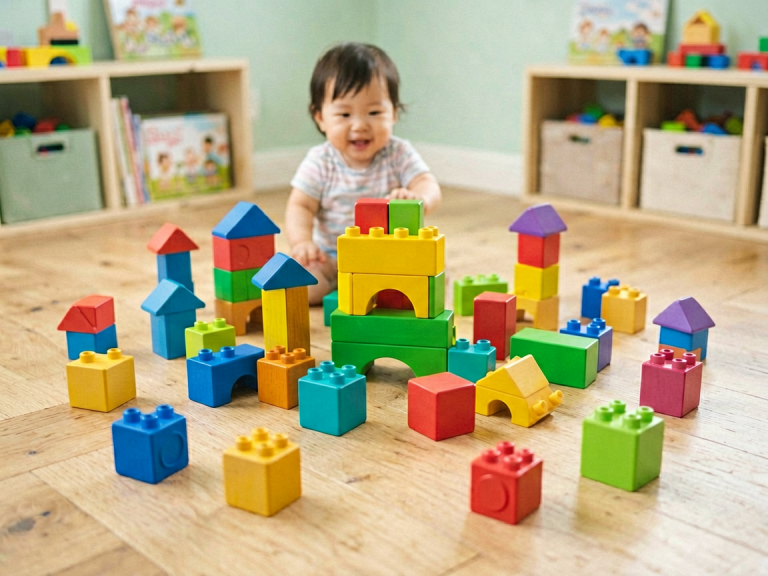
- Large Wooden Unit Blocks: Smooth, unpainted hardwood blocks in various shapes (rectangles, squares, cylinders, arches) offer open-ended possibilities. They are heavy enough to feel substantial but light enough for a toddler to lift. Children can build towers, bridges, enclosures, or roads. The natural texture is also appealing for sensory exploration.
- Soft Foam Blocks: These are perfect for the youngest 2-year-olds who are still prone to throwing. Foam blocks are silent, safe, and often come in bright colors. Some sets are shaped like animals or vehicles, encouraging pretend play.
- Magnetic Building Tiles (Large Size): Magnetic tiles with chunky, magnetized edges allow toddlers to connect shapes easily. They can create 2D and 3D structures. The satisfying click when tiles snap together provides instant feedback. Look for sets with oversized pieces to avoid choking hazards.
- Interlocking Plastic Bricks (Duplo or Compatible): These are scaled-up versions of classic building bricks, designed for small hands. They promote fine motor precision and creativity. Sets with simple themes—a fire station, a farm, or a train—add narrative possibilities.
- Cardboard Building Bricks: These are lightweight, large, and often shaped like bricks. Children can stack them to build walls or houses. They are inexpensive and can be decorated with crayons or stickers, adding an art component.
- Ramps and Rollers: Sets that include a sloped track and balls or cars encourage the child to explore gravity and motion. Observation of the rolling object helps develop prediction skills.
How to Engage Your 2-Year-Old with Building Toys
Parents play a crucial role in maximizing the benefits of building toys. First, create a safe, spacious play area. A low table or a clear floor space works well. Show the child how to stack a few blocks, then let them imitate. Do not take over—allow the child to lead the play.
Use descriptive language: “You put the green block on top of the yellow one. Now it’s tall!” This builds vocabulary and reinforces concepts. Ask open-ended questions: “What shall we build next?” or “How can we make it not fall?” Even if the child cannot answer fully, they are processing the question.
Encourage pretend play. If the child stacks three blocks, say, “Is that a house? Who lives there?” This bridges construction and storytelling. Allow the child to knock down towers occasionally—it is part of the learning process.
Rotate toys to maintain interest. Keep only a few building sets available at a time and swap them every week or two. This prevents boredom and keeps the play fresh.
Conclusion: Building a Foundation for Lifelong Learning
Building toys for 2-year-olds are far more than simple amusements. They are sophisticated educational instruments that nurture cognitive development, fine and gross motor skills, emotional resilience, and social cooperation. By carefully selecting safe, age-appropriate toys and engaging in thoughtful interaction, parents can transform playtime into a rich learning experience. The towers that rise and fall on a living room floor today are the foundations of problem-solving, creativity, and perseverance that will support a child for a lifetime. So the next time you hand a child a block, remember: you are not just giving them a toy—you are giving them a tool to build their future.