The Power of Building Toys: Unlocking Creativity and Development in 4-Year-Olds
Introduction
At the age of four, children stand at a remarkable crossroads of cognitive, physical, and social-emotional growth. Their imaginations are vivid, their hands are increasingly dexterous, and their curiosity about how the world works is insatiable. Building toys—those wonderfully simple yet profoundly complex sets of blocks, connectors, and shapes—offer more than just entertainment. They serve as essential tools for learning, providing a hands-on, open-ended platform where a child can experiment, fail, rebuild, and triumph. However, not all building toys are suitable for a four-year-old’s specific developmental stage. The right choices can foster problem-solving skills, fine motor control, spatial reasoning, and even early literacy and math concepts. This article explores the unique value of building toys for 4-year-olds, offers guidance on what to look for when selecting them, and highlights some of the most effective types available. By understanding the science and magic behind these simple playthings, parents and educators can turn playtime into a powerful engine for growth.
Why Building Toys Matter for 4-Year-Olds
A Stage of Rapid Cognitive Expansion
Four-year-olds are entering what developmental psychologists call the “preoperational stage,” characterized by symbolic thinking, an improved ability to follow sequences, and a growing understanding of cause and effect. Building toys directly feed these emerging capabilities. When a child stacks blocks to create a tower, they are not merely playing; they are testing hypotheses: *Will this block stay balanced if I put a heavier one on top?* *What happens if I push the base?* These small experiments form the foundation of scientific reasoning. Moreover, building requires working memory—the child must hold a mental image of what they want to create while simultaneously manipulating physical pieces. This dual-processing strengthens neural connections that are crucial for later academic tasks like reading and mathematics.
Physical Development: From Gross to Fine Motor Mastery
At age four, children have largely mastered gross motor skills such as running and jumping, but fine motor skills—the precise coordination of small muscles in the fingers and hands—are still maturing. Building toys are exceptional tools for refining these skills. Grasping a small block, aligning it with another, and applying the right amount of pressure to snap or stack requires practice. Activities like pushing a LEGO® Duplo brick into place, threading wooden beads onto a string, or connecting magnetic tiles demand finger strength and bilateral coordination (using both hands together). These very same skills underpin later writing, drawing, and using scissors. Unlike passive screen-time, building toys engage the child’s entire hand and brain in a purposeful, repetitive yet varied activity that strengthens muscles and neural pathways simultaneously.
Social and Emotional Learning Through Play
While often solitary, building play can also be deeply social. When four-year-olds build together, they must negotiate, share ideas, and collaborate. They learn to manage frustration when a tower collapses, to ask for help, and to celebrate a shared success. These experiences build emotional resilience and empathy. Furthermore, building toys provide a safe space for a child to feel a sense of control and mastery. In a world where so much is adult-directed, being the architect of one’s own small universe is incredibly empowering. That feeling of “I made this!” boosts self-esteem and motivates further exploration. For children who are naturally more reserved or anxious, building can be a calming, meditative activity that allows them to process emotions through constructive creation.
Key Characteristics of Ideal Building Toys for 4-Year-Olds
Safety and Age-Appropriate Size
Safety is paramount. At four, children still occasionally put objects in their mouths, though less frequently than toddlers. Toy pieces should be large enough to prevent choking—generally larger than 1.25 inches in diameter. Sharp edges, toxic paints, and small magnets are absolute no-nos. Look for toys that meet ASTM or CE safety standards. The material matters too; natural wood with non-toxic finishes is often preferred for its durability and tactile warmth, though high-quality plastic (like ABS) is perfectly safe when free of BPA and phthalates.
Open-Endedness and Flexibility
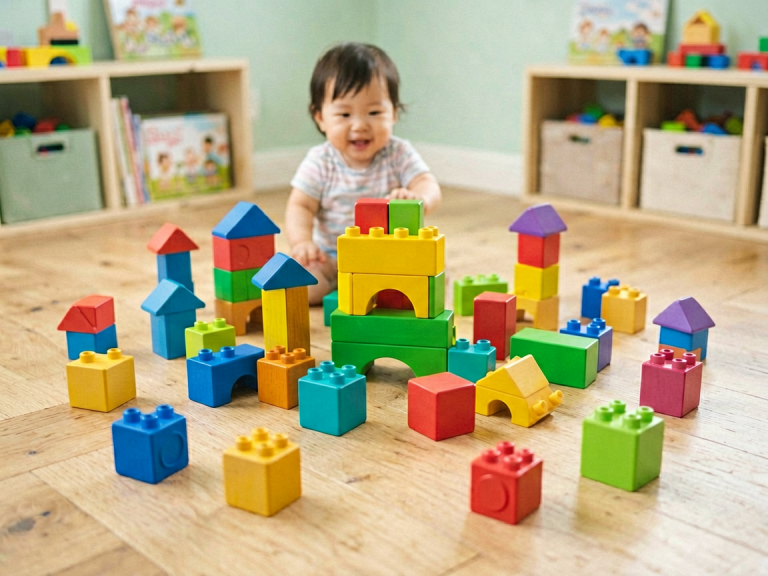
The best building toys for four-year-olds are not those that come with a single rigid instruction manual, but those that can be combined and recombined in endless ways. Open-ended toys—such as plain wooden blocks, magnetic tiles, or simple interlocking bricks—allow a child to follow their own imagination rather than a prescribed outcome. This fosters divergent thinking, the ability to generate multiple solutions to a problem. Conversely, toys that only snap together one way or that have a single specific model to build (like a pre-formed castle) can be limiting and lead to boredom once the model is complete. Of course, a few guided sets can be enjoyable as a challenge, but the core collection should encourage free creation.
Ease of Connection and Disassembly
Four-year-old hands are still relatively weak. Building toys must be easy to manipulate. Blocks that are too tight to pull apart or connectors that require adult strength will lead to frustration and abandonment. Look for systems with a light snap or a simple stack-and-balance design. Magnetic building tiles, for instance, require almost no force to connect—they just click together. Similarly, large LEGO Duplo bricks have a satisfying but easy-to-separate clutch. The child should be able to deconstruct their creation without needing help, as the process of taking apart is itself a valuable learning experience about disassembly and reuse.
Visual and Tactile Appeal
Children are drawn to bright colors and interesting textures. Building toys that incorporate a variety of shapes (squares, triangles, arches, cylinders) and colors stimulate visual discrimination and categorization. Translucent magnetic tiles add an extra dimension when used on a light table or near a window, teaching about light and color mixing. Wooden blocks with natural grain provide a different sensory experience—cool, smooth, with a slight weight. The more sensory variety a toy offers, the more it engages a child’s developing brain.
Top Types of Building Toys for 4-Year-Olds
Wooden Unit Blocks
The classic wooden unit block set is the gold standard of building toys for this age. These blocks are precisely cut in mathematical ratios (e.g., the length of one block equals the width of two smaller ones), which subtly teaches fractions, symmetry, and geometry. Four-year-olds can build towering skylines, bridges, animal enclosures, and castles. The simplicity of the blocks means the child must rely on gravity and balance rather than locks or magnets, which deepens their innate understanding of physics. Brands like Melissa & Doug or Guidecraft offer sets that can last for years. These blocks are also excellent for cooperative play: several children can build a shared city, learning to negotiate space and materials.
Magnetic Building Tiles
Magnetic tiles (such as Magna-Tiles or PicassoTiles) have become enormously popular for good reason. They consist of clear or colored plastic squares, triangles, and other shapes with magnets embedded in the edges. They are incredibly easy to connect—just bring two edges close and they snap. This low-friction connection allows even very young children to build 3D structures like cubes, houses, rockets, and more. The transparency of the tiles adds a visual wow factor: children can see inside their creations, exploring concepts of volume and negative space. Many sets include wheels, windows, or decorative stickers, extending the play possibilities. One caution: ensure the magnets are strong enough to hold structures but not so strong that they pinch little fingers (quality brands design for safety). Magnetic tiles are especially good for introducing geometric concepts and for children who get frustrated with blocks that topple easily.
Large Interlocking Bricks (e.g., LEGO Duplo)
LEGO Duplo is the larger, toddler-friendly version of classic LEGO bricks. At age four, children can follow simple picture instructions to build a fire truck or a farm, but they are equally happy free-building. Duplo bricks are large enough to be safe and easy to grip, yet they still require a bit of pressure to connect, which provides excellent finger-strengthening practice. The sets often include mini-figures, animals, and vehicle bases, which encourage imaginative story-telling. A city built from Duplo can become a setting for a child’s narrative play—the firefighter rescues the cat, the train carries passengers to the market. This blending of building and pretend play is especially rich for four-year-olds. Moreover, Duplo is compatible with standard LEGO (though the smaller versions are not recommended until age 5+), so the investment can transition to the next stage.
Simple Construction Sets with Wheels and Axles
Four-year-olds are fascinated by things that move. Construction sets that include wheels, axles, and connectors—like those from K’NEX (the Kid K’NEX line for ages 3-5) or simple gear sets—allow children to build vehicles that actually roll. The challenge of attaching wheels stably teaches about symmetry and alignment. These sets often come with rods and clips that require a bit more dexterity than blocks, offering a slightly higher level of difficulty. Children learn that a car with wheels that are not parallel will wobble; they adjust, try again, and succeed. This cause-and-effect feedback is immediate and satisfying. Such sets also naturally introduce basic engineering concepts like axles, pivots, and friction.
Foam or Cardboard Building Blocks
For lightweight, safe, and quiet building, large foam blocks (often found in preschool classrooms) are ideal. They are soft, so towers that fall cause no damage and little noise. They are also large, encouraging gross motor movement—children lift, carry, and stack these blocks, engaging their whole bodies. Cardboard bricks (like those from Imagination Playground) are another excellent option: they are hollow, lightweight, and can be assembled into forts, walls, and rocket ships. These blocks are especially good for cooperative, large-scale building projects where several children work together. They are less precise than wooden blocks, but this imprecision encourages creative problem-solving.
Developmental Benefits: What Children Really Learn
Cognitive Skills: Math, Science, and Logic
Building toys are stealthy math tutors. As children sort blocks by shape or color, they practice classification. When they try to make two sides of a tower equal, they engage with symmetry. Counting blocks during construction reinforces one-to-one correspondence. Understanding that a tall tower needs a wide base introduces the concept of stability—a core physics principle. Research has shown that children who engage in frequent block play perform better in spatial reasoning tests, which are strong predictors of success in STEM fields. Furthermore, planning a structure requires executive function skills: the child must inhibit the impulse to just pile blocks randomly, hold a goal in mind, and sequence actions. These are the same neural circuits that later help with essay writing and long-term project planning.
Motor Skills: From Fine to Gross
The fine motor demands of manipulating small blocks were mentioned earlier, but gross motor skills are also engaged when children carry a bin of heavy wooden blocks, reach high to place a top block, or walk around a large foam structure. Building involves whole-body movements, especially when children are constructing something that requires them to squat, stretch, or balance. This integrated physical activity is far more beneficial than isolated exercises because it is purposeful and engaging.
Language and Literacy
While building, children often talk to themselves or to others: “I’m making a garage for the red car.” “This block is too big. I need a small one.” This self-talk and social talk builds vocabulary (words like *balance, foundation, arch, cylinder*), narrative skills, and the ability to describe spatial relationships. Parents can enhance this by asking open-ended questions: “How did you make that bridge stay up?” or “Can you tell me a story about your castle?” Such interactions turn building into a rich language experience. Additionally, some building sets come with picture-based instructions, which are an early form of reading—interpreting symbols and sequences.
Social-Emotional Growth
Building with others teaches patience, turn-taking, and compromise. A child might have to wait while a friend uses a specific piece, or agree to modify their own design to incorporate a friend’s idea. When a structure collapses, the child experiences disappointment but also learns that failure is temporary and fixable. The process of rebuilding develops perseverance. Over time, children become more confident in their ability to tackle challenges, because they have repeatedly experienced that effort leads to success. For children who are naturally more inclined toward solitary play, building offers a low-pressure way to transition into cooperative play—perhaps starting with parallel building (each building their own small structure) and gradually sharing materials.
How to Choose and Introduce Building Toys
Start with a Core Set, Then Expand
It is better to buy one high-quality, versatile set than many cheap, specialized ones. A set of 50–100 wooden unit blocks or a 60-piece magnetic tile set will provide months of play. After the child has mastered the basics, you can add specialized pieces like wheels, arches, or people. Avoid the temptation to buy sets with a specific theme (e.g., a princess castle kit) as the only option, as the child may become stuck trying to replicate that one design. Instead, let the child’s interests guide expansions: if they love building tall towers, add more columns; if they enjoy making enclosures, add more flat squares.
Model, but Don’t Over-Instruct
Adults can show a child how to build a stable base or how blocks can be used to create an arch, but the best learning comes from free exploration. Sit on the floor with your child and build your own structure nearby. Narrate your own thinking: “I wonder if I can make a door. I’ll put a flat block here and another on top…” This models problem-solving without taking over. Resist the urge to correct or “fix” the child’s creation unless it poses a safety hazard. Lopsided towers are learning opportunities.
Create a Dedicated Building Space
Having a flat, clear surface—a table or a section of the floor—with a storage bin for blocks encourages spontaneous building. A shelf at the child’s eye level allows them to choose their materials independently. Rotating toys occasionally (e.g., swapping magnetic tiles for wooden blocks every few weeks) keeps interest fresh. Also, consider adding other loose parts (like small toy animals, people, or fabric scraps) that can be incorporated into the building play. This open-endedness extends the life of the toys and fosters creativity.
Encourage Documentation and Storytelling
After a child finishes a creation, take a photo and print it, or have the child draw a picture of it. This validates their work and creates a record of progress. Ask the child to tell you a story about their building: who lives there, what happens, what is the building’s purpose? This transposes the physical play into linguistic and narrative domains, reinforcing the connection between building and communication. Some families keep a “construction journal” where the child can paste photos and dictate captions. This simple practice builds early literacy skills and pride.
Conclusion
Building toys for 4-year-olds are far more than simple playthings; they are catalysts for comprehensive development. From the humble wooden block to the modern magnetic tile, these toys offer a rare combination of fun and profound learning. They strengthen tiny hands and growing brains, teach persistence in the face of failure, and spark a lifelong curiosity about how things work. Choosing the right building toys—safe, open-ended, and engaging—is an investment in a child’s cognitive, motor, and social-emotional future. As parents and educators, we can best support four-year-olds not by providing more toys, but by providing better ones—and then stepping back to let the child’s imagination do the rest. So, clear a space on the floor, open a bin of blocks, and watch a world of possibility unfold. The tower may fall, but the learning stands tall.