Beyond Blocks: The Cognitive and Creative Power of Building Toys for 6-Year-Olds
Introduction: The Age of Discovery
At six years old, a child stands at a remarkable crossroads of development. They have left behind the chaos of toddlerhood, mastered the basics of language and social interaction, and are now entering a phase of explosive cognitive growth. Their fine motor skills have sharpened enough to tie shoelaces and hold pencils with control; their imagination has become vivid enough to conjure entire kingdoms from cardboard boxes. It is precisely at this age that building toys—whether classic wooden blocks, magnetic tiles, interlocking plastic bricks, or more sophisticated construction sets—transcend mere playthings. They become tools for thinking, problem-solving, and self-expression. In this article, we will explore why building toys are essential for 6-year-olds, what specific types work best, and how parents and educators can leverage these toys to foster lifelong skills.
The Developmental Sweet Spot: Why 6-Year-Olds Are Primed for Building
To understand the importance of building toys for six-year-olds, we must first examine the developmental milestones typical of this age. At six, children are moving from preoperational to concrete operational thinking, according to Piaget’s theory. They begin to understand concepts like conservation (the idea that quantity remains the same despite changes in shape), cause and effect, and spatial relationships. Building toys directly challenge and nurture these emerging cognitive abilities. When a child stacks blocks to make a tower, they are not just playing—they are experimenting with gravity, balance, symmetry, and geometry. They learn that a wide base provides stability, that a heavy piece placed on top of a fragile one will topple the structure, and that triangles can reinforce squares. These are not lessons taught in a classroom; they are discoveries made through trial and error.
Socially, 6-year-olds are also more capable of cooperative play. Building together with a sibling or friend teaches negotiation, shared goal-setting, and conflict resolution. “I want the red brick!” “No, we need it for the roof!” These micro-dramas are practice for real-world collaboration. Furthermore, the fine motor demands of manipulating small pieces—snapping, stacking, twisting—refine the hand muscles needed for writing and other precise tasks.
Key Categories of Building Toys for 6-Year-Olds: A Practical Guide
Not all building toys are created equal. For a 6-year-old, the ideal toy balances challenge with success, complexity with safety, and open-ended creativity with structured guidance. Below are the most effective categories, each with distinct benefits.
Classic Wooden Blocks: The Timeless Foundation
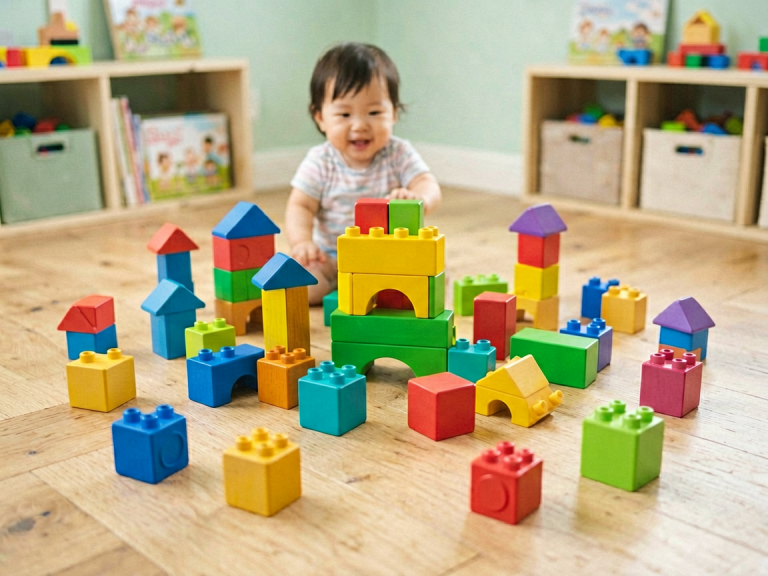
Before the digital age, before plastic, there were wooden blocks. And they remain one of the best building toys for a 6-year-old. Unlike interlocking systems, wooden blocks rely entirely on friction and gravity. This lack of a locking mechanism forces a child to consider weight distribution, surface area, and alignment. A tower of wooden blocks can collapse with the slightest misalignment, teaching the child the value of patience and precision. Sets that include arches, cylinders, triangles, and rectangles allow for the creation of bridges, castles, and abstract sculptures. For a 6-year-old, the open-ended nature of wooden blocks is liberating: there are no instructions, no right or wrong way to build. This fosters divergent thinking—the ability to generate multiple solutions to a single problem.
Interlocking Plastic Bricks: The Universal Language of Construction
No discussion of building toys would be complete without the ubiquitous interlocking bricks, most famously associated with LEGO. For a 6-year-old, standard LEGO sets (with bricks of appropriate size) are ideal. The key is to choose sets that are not too complex—perhaps 100 to 200 pieces, with clear but not overwhelming instructions. These sets often come with themes like fire stations, farms, or space rockets, which provide a narrative context. The child learns to follow sequential steps, a precursor to reading procedural texts and coding. More importantly, after building the model once, the child is free to disassemble and create their own designs. This transition from following instructions to inventing is where true cognitive growth happens. Many experts recommend buying mixed boxes of basic bricks rather than always sticking to themed sets, as the latter can limit creativity.
Magnetic Building Tiles: Geometry Meets Magic
Magnetic tiles (such as Magna-Tiles or PicassoTiles) have surged in popularity, and for good reason. They are safe, easy to connect, and visually stunning. For a 6-year-old, the magnets provide an immediate sense of satisfaction because pieces click together effortlessly. This allows the child to focus on design rather than dexterity. Soft-touch magnetic tiles with rounded edges are ideal for young hands. Children can build 3D shapes like cubes, pyramids, and even geodesic domes. The transparent colored tiles also allow for exploration of light and color mixing when held up to a window or a flashlight. One of the greatest benefits of magnetic tiles is that they teach structural integrity in a forgiving way: if a wall is not properly aligned, the magnets still hold, but the structure may wobble, prompting the child to adjust. This iterative process is a microcosm of engineering design.
Construction Kits with Connectors: Wheels, Gears, and Motion
While static structures are valuable, 6-year-olds are often fascinated by things that move. Construction kits that include wheels, axles, gears, hinges, and pulleys introduce the concept of mechanical motion. Popular examples include K’NEX, Meccano (junior versions), or even simple marble runs. These toys require a slightly higher level of spatial reasoning because the child must not only connect pieces but also ensure that rotating parts align and gears mesh. Building a car that can actually roll down a ramp, or a crane that can lift a small weight, gives the child a tangible sense of cause and effect. They learn that the diameter of a wheel affects speed, that a longer axle provides more stability, and that a gear ratio can increase torque. For a 6-year-old, these are not abstract formulas—they are physical truths discovered through play.
The Role of Parental Guidance and Open-Ended Play
No matter how well-designed a building toy is, its potential is maximized when supported by an engaged adult. Parents and caregivers should resist the urge to take over and “fix” a child’s wobbly tower. Instead, they can ask open-ended questions: “What do you think will happen if you add another block on that side?” or “How could you make the bridge stronger?” This Socratic approach nurtures the child’s metacognition—their ability to think about their own thinking. It also encourages resilience: when a structure falls, a child with a supportive adult will see it as a learning opportunity rather than a failure.
However, it is equally important to allow independent play. Some of the most creative building happens when children are alone with their toys, free to daydream and experiment without interruption. The balance between guidance and freedom is delicate. One effective strategy is the “10-minute rule”: spend the first ten minutes playing together, demonstrating a new technique or discussing possibilities, then gradually step back and let the child take the lead.
Safety Considerations for Building Toys at Age Six
While 6-year-olds are more capable than toddlers, safety remains a priority. Avoid toys with small parts that could be choking hazards for younger siblings, but also check for sharp edges, toxic paints, and magnets that are too strong (rare in modern magnetic tiles, but worth verifying). Interlocking bricks should be stored in containers without small gaps where fingers could get trapped. Also, consider the material: high-quality wood that is sanded smooth and sealed with non-toxic finish is preferable to cheap plastic that may splinter or break. For magnetic tiles, ensure that the magnets are securely encased so they cannot pop out. The American Academy of Pediatrics recommends that parents inspect toys regularly for wear and tear.
Beyond the Toy Box: Integrating Building into Daily Life
The principles of building do not have to be confined to a designated play area. Everyday household items—cardboard boxes, toilet paper rolls, string, tape, and recycled containers—make excellent building materials. A 6-year-old can construct a fort from cushions and blankets, design a marble run from paper towel tubes, or create a city from shoeboxes. These activities reinforce the same problem-solving skills as commercial building toys, but with the added benefits of creativity and resourcefulness. Encourage children to draw their designs before building, or to take photographs of their creations to document their progress over time.
The Long-Term Impact: From Play to Passion
Research in developmental psychology has consistently shown that children who engage in construction play tend to develop stronger spatial visualization skills, which are linked to success in STEM fields (science, technology, engineering, and mathematics). More importantly, building toys teach a growth mindset: the belief that abilities can be developed through effort. A child who struggles to build a stable bridge and eventually succeeds learns that persistence pays off. This lesson is far more valuable than any single construction.
As a six-year-old grows, they may graduate to more complex sets: robotics kits, architectural models, or even digital building games like Minecraft. But the foundation—the tactile, hands-on experience of connecting physical pieces to create something new—remains invaluable. The block tower that falls today is the skyscraper designed tomorrow. The wobbly car that rolls two inches is the future engineer’s first prototype.
Conclusion: Building a Future, One Block at a Time
In a world increasingly dominated by screens and passive entertainment, building toys offer a rare and precious gift: the opportunity to be a creator. For a 6-year-old, every piece is a possibility, every structure a story, and every collapse a lesson. Whether you choose classic wooden blocks, magnetic tiles, or interlocking plastic bricks, the key is to provide variety, encourage exploration, and celebrate the process over the product. When we give a child a set of building toys, we are giving them more than a plaything. We are giving them a language for problem-solving, a canvas for imagination, and a lifelong love for learning. So the next time you see a six-year-old carefully placing one block on top of another, remember: they are not just building a tower. They are building a mind.