Building Brilliance: The Essential Guide to Choosing Building Toys for 3‑Year‑Olds
Introduction: Why Building Toys Matter at Age Three
At three, a child is no longer a toddler but a burgeoning explorer of cause, effect, and imagination. Their fine motor skills have advanced enough to grasp, stack, and connect, while their cognitive world is expanding rapidly. Building toys—blocks, magnetic tiles, interlocking bricks, and more—are not just entertainment; they are the raw materials for brain development. For a 3‑year‑old, the act of constructing a tower, a bridge, or a simple house is a profound lesson in physics (gravity, balance), logic (what fits where), and creativity (how to turn a pile of pieces into a story). However, choosing the right building toys for this age requires careful thought. The market is flooded with options, but not all are safe, developmentally appropriate, or genuinely engaging. This guide explores the critical considerations, top categories, and practical tips for parents and educators seeking to nurture a 3‑year‑old’s innate drive to build.
—
Understanding the Developmental Landscape of a 3‑Year‑Old
Before diving into product recommendations, it is essential to understand what a 3‑year‑old’s body and mind are ready for.
Physical Growth and Fine Motor Control
By age three, most children can stack several blocks, turn knobs, and manipulate pieces with a pincer grasp. However, their hand strength and coordination are still developing. Toys that require excessive force to snap together (like many small LEGO® bricks) can frustrate them. Instead, look for pieces that are large enough to be easily gripped—ideally at least 1–2 inches in diameter—and that connect with minimal pressure.
Cognitive Milestones
Three-year-olds are in the preoperational stage (Piaget), where symbolic thinking blooms. They may pretend a stack of blocks is a castle or a train track. They also begin to understand simple sequences and categorizations. Building toys that encourage repetition, pattern-making, and open-ended play are ideal. At this age, the process matters far more than the product; a crooked tower that collapses is a lesson, not a failure.
Safety and Choking Hazards
The single most important factor: any part of a building toy must be too large to fit through a standard toilet paper tube (approximately 1.25 inches in diameter). Even if a child no longer mouth objects constantly, 3‑year‑olds still explore with their mouths when tired or distracted. Additionally, avoid toys with sharp edges, small magnets that could be swallowed, or toxic paints and plastics. Certification marks like ASTM (American Society for Testing and Materials) or CE (Conformité Européenne) provide basic reassurance.
—
Top Types of Building Toys for 3‑Year‑Olds
Not all building toys are created equal. Below are the most effective categories, with examples and reasoning for their suitability.
1. Classic Wooden Blocks
Wooden unit blocks remain the gold standard for open-ended construction. Their simplicity—no clips, no magnets—lets a child focus on balance, weight, and shape. A set of 50–100 smooth, unpainted hardwood blocks in various geometric forms (rectangles, triangles, cylinders, arches) can occupy a 3‑year‑old for hours. Look for blocks with rounded edges and non‑toxic finishes. Brands like Melissa & Doug or Hape offer excellent starter sets.
*Why they work:* They are forgiving. A block can be a roof, a car, or a table. There is no “wrong” way to use them. Research shows that playing with wooden blocks boosts spatial reasoning and math readiness.
2. Large Interlocking Bricks (Duplo or Compatible)
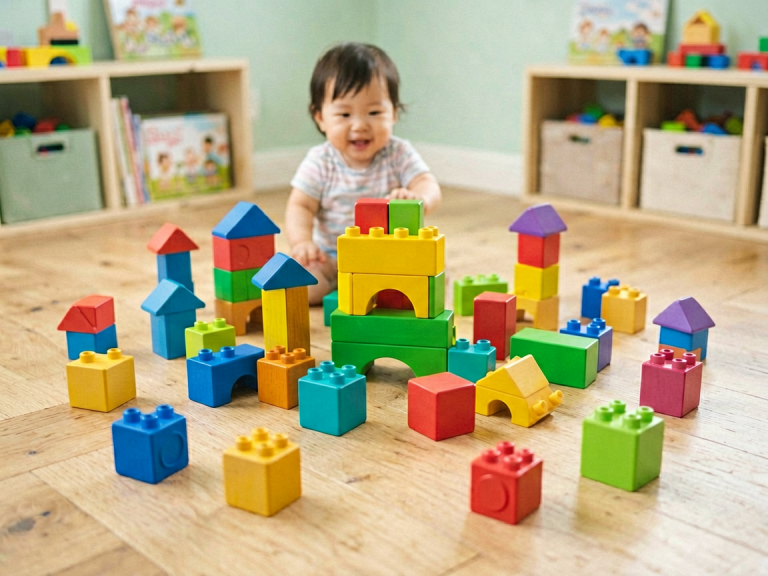
Duplo bricks, made by LEGO, are twice the size of standard LEGO bricks, making them safe and easy for small hands. They connect with a satisfying click but require only moderate grip strength. Three-year-olds can build simple towers, walls, or animals. The key is to avoid sets with too many specialized pieces (e.g., complex wheels, tiny accessories). Stick with basic brick sets and add a few friendly figures or animals.
*Why they work:* They introduce the concept of interlocking without frustration. Children learn to align studs and holes, developing hand-eye coordination and planning.
3. Magnetic Building Tiles (e.g., Magna‑Tiles, PicassoTiles)
Magnetic tiles have become a modern classic. These translucent, plastic squares and triangles contain strong magnets along their edges, allowing children to snap them together to form 2D shapes or 3D structures. For 3‑year‑olds, larger tiles (at least 3 inches wide) are best. Magnets are securely encased, so there is no risk of ingestion.
*Why they work:* The magnetic “click” is instantly gratifying. Children can build vertically (towers) or horizontally (houses on the floor). The transparency also lets them see how pieces align, reinforcing spatial visualization.
4. Stacking and Nesting Toys
While not traditional “building” toys, stacking rings, nesting cups, and graduated blocks are excellent precursors. They teach size relationships, sequencing, and cause‑and‑effect (if you stack the largest cup first, the tower stands). Look for sets with textures, colors, or patterns to stimulate sensory exploration.
*Why they work:* They are almost foolproof. The frustration level is low, and success is achievable. They build confidence for more complex constructions.
5. Soft Foam Blocks and Fabric Building Sets
For families who worry about hard blocks falling on toes or furniture, foam blocks—lightweight, oversized, and colorful—are a safe alternative. Some sets include interlocking fabric squares with Velcro or snap buttons. These are ideal for roughhousing, falling towers, and very young builders.
*Why they work:* They eliminate fear of injury. Children can build tall towers and knock them down with laughter, learning about gravity without tears.
—
Practical Tips for Parents and Educators
Even the best toy is only as good as the environment that supports it. Here are actionable strategies for maximizing the learning potential of building toys.
Create a “Yes” Space
Designate a low-shelf bin or a floor mat where building toys live. Avoid overstimulating clutter; a small, curated selection (e.g., 60 wooden blocks + 20 magnetic tiles) encourages deeper focus. Rotate toys weekly to maintain novelty.
Model Without Taking Over
A 3‑year‑old learns by watching but also needs agency. Sit alongside them and build your own tower while narrating your actions: “I’m putting the big block at the bottom so it’s steady.” Then let them imitate or ignore you. Never rebuild their “messy” creation without asking; to them, that crooked pile is a masterpiece.
Encourage Problem-Solving Language
Ask questions that prompt thinking, not performance. “What happens if you put the triangle on top?” or “How can we make this tower not fall?” Avoid “Good job!” and instead describe: “I see you placed the blue block next to the red one—that makes a pattern.”
Embrace the Destruction
Knocking down a tower is not a sign of aggression; it is a scientific experiment. Gravity, sound, motion—all are being tested. After the crash, ask, “What made it fall? Was it too tall? Did the bottom wobble?” Then invite rebuilding.
—
Avoiding Common Pitfalls
Several well‑intentioned choices can backfire with 3‑year‑olds. Here is what to avoid.
- Small parts and choking hazards: Even if a toy is labeled “3+,” inspect it yourself. Some cheaper sets include loose beads or tiny wheels that can break off.
- Overly complex instructions: Sets that require following a multi‑step diagram (e.g., “build a helicopter with 47 pieces”) will frustrate a 3‑year‑old. Stick to open‑ended kits.
- Toys that promote only one outcome: A block set that only makes a pre‑formed car (like a snap‑together vehicle) limits creativity. The best building toys have no final “correct” form.
- Screen‑based building apps: While digital building games exist, a 3‑year‑old learns best through physical manipulation. Real blocks provide proprioceptive feedback that a touchscreen cannot.
—
Conclusion: The Foundation of a Lifetime Love for Learning
Choosing building toys for a 3‑year‑old is not about buying the most expensive set or the trendiest brand. It is about understanding that at this age, every piece is a brick in the child’s growing understanding of the world. Wooden blocks teach patience and balance. Magnetic tiles teach geometry and magnetism. Duplo bricks teach connection and planning. But above all, these toys teach that the child’s own hands and mind are powerful tools. When a 3‑year‑old places the last block on a wobbly tower and it stands—even for a moment—they are not just building a structure. They are building confidence, resilience, and the knowledge that they can shape their environment. And that, more than any finished castle, is the true masterpiece.
*Word count: ~1,280 words*