Beyond the Playroom: The Distinct Worlds of Science Toys and Engineering Toys
Introduction: More Than Just Play
Toys have always been the silent architects of childhood. They shape curiosity, inspire creativity, and, perhaps most importantly, teach children how to interact with the world. Among the vast landscape of educational playthings, two categories stand out for their profound impact on cognitive development: science toys and engineering toys. At first glance, they might seem interchangeable—both involve building, experimenting, and problem-solving. Yet each category engages a fundamentally different set of mental muscles. Understanding the distinction between science toys and engineering toys is not merely an academic exercise; it is a practical guide for parents, educators, and anyone invested in nurturing a child’s natural inclination to learn. This article will dissect the core philosophies, educational functions, and developmental benefits of these two toy families, and argue that both are essential, though they serve unique purposes in a child’s intellectual journey.
Defining Science Toys: The Art of Inquiry
Science toys are designed to ignite the spirit of investigation. They encourage children to ask “why” and “what if”—to observe phenomena, formulate hypotheses, and test them through controlled exploration. A classic science toy might be a chemistry set, a solar system model, a microscope, or a crystal-growing kit. These toys do not necessarily produce a tangible structure; instead, they produce an experience or a demonstration of a natural law.
Consider a simple prism: when a child shines light through it, she sees a rainbow. The toy itself is not complex, but the lesson is profound—light is composed of different wavelengths. A science toy’s primary goal is to reveal a principle of nature. It invites the child to become a mini-scientist, to record observations, to notice patterns, and to draw conclusions. The process is open-ended. There is no single “correct” outcome; rather, the child learns that nature behaves according to rules that can be discovered.
Moreover, science toys often cultivate patience and humility. A growing crystals experiment may fail if the solution is too hot or too cold. A baking soda volcano might fizzle rather than erupt. These “failures” are not setbacks; they are data. They teach the child that the natural world does not bend to wishes, but yields answers only to careful method. In this way, science toys build a foundation for the scientific method—observation, hypothesis, experimentation, and revision.
Defining Engineering Toys: The Art of Creation
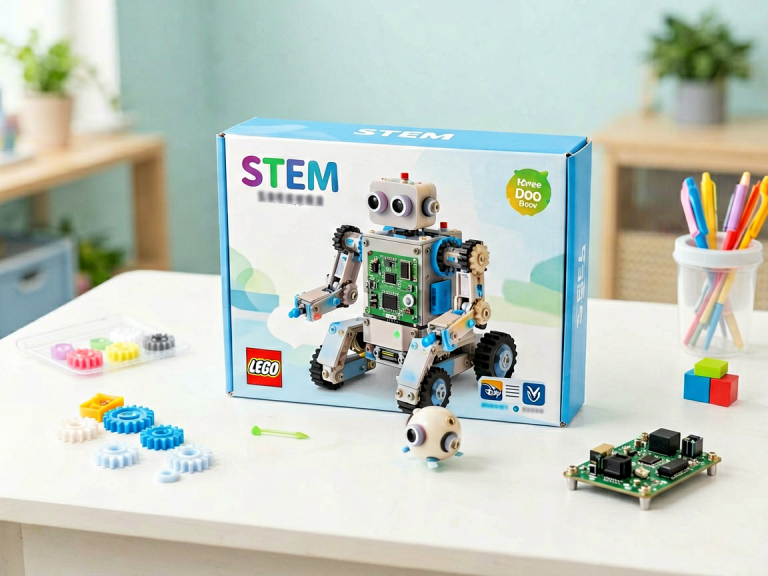
Engineering toys, in contrast, are focused on design, construction, and function. They challenge children to ask “how” and “what works”—to take materials and assemble them into a system that performs a specific task. Think of LEGO Technic, K’NEX, Meccano, or motorized building sets. These toys require the child to follow instructions or, even better, to invent their own blueprints. The output is a physical object: a bridge that holds weight, a crane that lifts a load, a car that rolls down a ramp.
The essence of an engineering toy is constraints. A child building a structure with limited pieces must consider stability, load distribution, and balance. When a tower topples, the lesson is not about natural law but about design flaws: the base was too narrow, the joints too weak. The child must revise the design, reinforcing weak points, redistributing mass, or trying a different geometry. This iterative process mirrors real-world engineering—a blend of creativity, mathematics, and practicality.
Engineering toys also cultivate a sense of agency. The child is not just a passive observer of a phenomenon; she is an active creator. She sets a goal (build a bridge that can support a toy car) and then achieves it through effort and ingenuity. The satisfaction of a completed project is immediate and tangible. This builds confidence and a “can-do” attitude that is invaluable in later problem-solving contexts.
Key Differences in Philosophy and Approach
The dichotomy between science toys and engineering toys can be summarized by the classic distinction between basic research and applied science. Science toys ask: “How does the universe work?” Engineering toys ask: “How can I make something that works?” One is about understanding; the other is about building.
Take a simple example: a balloon-powered car. If you give a child the parts and ask her to assemble it, she is engaging in engineering—she must align the wheels, attach the balloon, ensure the axle rotates freely. If, instead, you give her a pre-built car and ask her to vary the amount of air in the balloon, measure the distance traveled, and graph the relationship, she is doing science. The same toy can serve both purposes, but the mindset is different.
Another distinction lies in error handling. In science, an unexpected result is a discovery. In engineering, an unexpected result is a malfunction. A child using a microscope might be thrilled to find a strange microbe she wasn’t looking for. A child building a robot arm might be frustrated when the servo fails. This difference in emotional texture is important: science tolerates (even celebrates) serendipity, while engineering demands precision and troubleshooting.
Furthermore, science toys typically require more abstract thinking—understanding invisible forces like magnetism or gravity—while engineering toys often involve concrete, visual feedback. A child can see the bridge sag, touch the loose joint, and feel the wobble. Science toys, by contrast, may require a leap of imagination to connect the observed effect to an underlying cause (e.g., why does the compass needle point north?).
Educational Benefits: Science vs Engineering
Both categories contribute uniquely to a child’s cognitive development. Science toys excel at fostering scientific literacy, critical thinking, and an appreciation for the natural world. A child who grows up with science toys learns that the world is understandable—that behind every mystery lies a mechanism. She develops a habit of asking questions and seeking evidence. These skills are foundational for any academic path, from medicine to environmental science.
Engineering toys, on the other hand, build spatial reasoning, mathematical intuition, and perseverance. Studies have shown that children who engage in construction play score higher on tests of mental rotation and geometric thinking. Moreover, engineering toys teach a growth mindset. When a structure collapses, the child does not say, “I’m bad at building.” She says, “My design needs improvement.” This resilience is a powerful life skill.
Interestingly, the two types of toys complement each other. A child who is fascinated by how a solar panel works (science) may later want to build a toy car powered by it (engineering). Conversely, a child who struggles with an engineering challenge may benefit from a deeper understanding of the underlying physics—why does a longer lever make lifting easier? The best educational approach is to provide both.
Developmental Impact by Age
The optimal age for introducing each category varies. For preschoolers (ages 3–5), engineering toys that involve large blocks, simple snap-together parts, or Duplo are ideal. At this stage, children are developing fine motor skills and cause-and-effect reasoning. Simple science toys like magnifying glasses, color-mixing water play, or floating-and-sinking experiments are excellent too, but they should be very hands-on and sensory-rich.
For elementary-aged children (ages 6–10), the possibilities expand. Science kits for growing crystals, building simple circuits, or observing insect life are appropriate. Engineering sets like LEGO Technic or magnetic tile structures allow for more complex designs. At this age, children can start to grasp the idea of variables: “What happens if I use a thicker string?” or “Will the car go faster with a larger wheel?”
For preteens and teenagers (ages 11+), more sophisticated options emerge. Science toys can include soldering kits, electronics labs, or chemistry equipment with actual (safe) chemicals. Engineering toys might involve robotics kits, 3D printing pens, or programmable microcontrollers like Arduino. At this stage, the line between toy and tool blurs, and children can engage in genuine prototyping and experimentation that mirrors professional practice.
Choosing the Right Toy for Your Child
Given the distinct benefits, parents and educators should not view science and engineering toys as competitors. Rather, they should consider the child’s natural inclinations. A child who is naturally curious about why stars twinkle or why ice floats might be drawn to science toys. A child who loves to build forts, take apart old appliances, or draw blueprints might prefer engineering.
However, it is wise to gently encourage exposure to the opposite category as well. A budding engineer could benefit from a science kit to understand the principles behind her structures. A young scientist could benefit from an engineering challenge to apply her knowledge in a tangible way. The goal is not to pigeonhole a child into one category, but to provide a balanced diet of inquiry and creation.
Finally, consider the quality of the toy. The best science and engineering toys are not necessarily the most expensive or high-tech. A simple set of wooden blocks can teach engineering principles of balance and stability. A jar of baking soda and vinegar can teach chemical reactions. The key is not the toy itself but the mindset it encourages—open-ended exploration for science, purposeful design for engineering.
Conclusion: Two Sides of the Same Coin
In the end, science toys and engineering toys are not opposites; they are complementary lenses through which children view the world. Science toys invite children to discover what already exists; engineering toys invite them to create what has never existed. Both are essential for raising a generation of thinkers, problem-solvers, and innovators.
A child who plays with a microscope today may become the biologist who discovers a new species tomorrow. A child who builds with LEGO Technic today may become the engineer who designs a sustainable bridge for a remote village. But more importantly, regardless of future careers, these toys teach children that the world is not a fixed place. It is a puzzle to be solved, a system to be understood, and a canvas to be reshaped.
So next time you step into a toy store, do not ask, “Which is better?” Instead, ask, “Which will open a new door for this child?” Provide both, and watch as the boundaries between science and engineering dissolve, leaving behind a child who knows that learning is not a subject—it is a way of living.
(Word count: approximately 1,280 words)