Unlocking Creativity and Focus: The Power of Independent Play Toys for Elementary-Age Children
In an era dominated by screens, scheduled activities, and constant adult supervision, the concept of independent play has become almost revolutionary. Yet for elementary-age children — those roughly between six and twelve years old — the ability to engage in self-directed, uninterrupted play is not just a pleasant pastime; it is a cornerstone of healthy development. The right independent play toys act as catalysts, transforming a child’s free time into a laboratory for creativity, problem-solving, and emotional regulation. This article explores why independent play matters at this critical stage, what makes a toy truly supportive of solo play, and how parents and educators can curate an environment that fosters deep, joyful, and autonomous exploration.
Why Independent Play Matters for Elementary Kids
Elementary school years are a period of tremendous cognitive and social growth. Children begin to develop more advanced reasoning, learn to manage complex emotions, and form their own identities separate from their parents. Independent play serves as a safe, low-stakes arena for practicing these emerging skills.
Cognitive development thrives when children are allowed to make their own decisions. During solo play, a child must choose what to do, how to proceed, and when to change course. This decision-making process strengthens executive functions such as planning, working memory, and cognitive flexibility. For example, building a complex structure with magnetic tiles requires a child to visualize a goal, sequence steps, and adapt when a tower collapses — all without an adult prompting the solution.
Emotional self-regulation is another profound benefit. When children play alone, they encounter small frustrations — a puzzle piece that doesn’t fit, a LEGO creation that falls apart — and they must manage those feelings internally. Over time, this builds resilience. They learn that a setback is not a disaster; they can take a breath, try again, or shift to a different approach. The toy itself becomes a companion in this emotional journey, offering challenges that are just difficult enough to stretch the child’s patience without overwhelming it.
Creativity flourishes in solitude. Without the pressure of a peer’s expectations or an adult’s suggestion, a child can invent entire worlds. A cardboard box becomes a spaceship; a set of colored pencils transforms into the palette for an alien landscape. Independent play toys that are open-ended — those with no single “right” way to play — invite children to generate their own narratives, rules, and outcomes. This is the raw material of innovation.
Moreover, independent play provides a necessary counterbalance to the highly structured, often overscheduled lives of many elementary kids. Between school, homework, extracurriculars, and family obligations, children have few pockets of time to simply *be*. Solitary play is a form of mental rest, allowing the brain to consolidate learning and decompress. It is not a luxury; it is a biological need.
Characteristics of Great Independent Play Toys
Not all toys are created equal when it comes to fostering independent play. The most effective ones share a set of key traits that invite sustained, self-directed engagement.
Open-endedness is perhaps the most important quality. Toys that can be used in multiple ways — such as wooden blocks, modeling clay, or a set of loose parts — never exhaust their play value. A child can build a castle today, a bridge tomorrow, and an abstract sculpture the next day. In contrast, a battery-operated toy that performs a single action (say, a robot that walks and makes noise) typically holds a child’s attention for a limited time because it offers no room for imagination.
Durability and simplicity matter enormously. Elementary kids are not always gentle; they drop, throw, and stomp. A toy that breaks easily creates frustration, not independence. High-quality materials like solid wood, sturdy plastic, or metal ensure that the toy can survive repeated use. Simplicity in design — few moving parts, no complicated instructions — allows the child to figure out the toy on their own terms. A complex electronic toy often requires adult setup or troubleshooting, which defeats the purpose of independence.
Appropriate challenge is a delicate balance. The toy should be neither too easy (leading to boredom) nor too difficult (leading to frustration). For elementary children, this often means toys that can grow with them. A set of advanced building bricks with specialized pieces, for instance, challenges a seven-year-old differently than a ten-year-old. Puzzles with increasing piece counts, strategy games for one player, or art kits with multiple techniques all provide a ladder of difficulty that the child can climb at their own pace.
Sensory engagement also enhances solo play. Toys that involve texture, sound, visual patterns, or physical movement capture attention more deeply than flat, static objects. Kinetic sand, marble runs, spinning tops, and weaving looms engage multiple senses simultaneously, which can be both calming and stimulating. For an elementary child who has spent the day in a busy classroom, a tactile, quiet toy offers a sensory reset.
Finally, the best independent play toys are screen-free. While some digital games can be educational, they often come with algorithms designed to maximize engagement through rapid rewards and constant novelty — a formula that can actually undermine the deeper focus that solo play requires. Physical toys demand patience, manual dexterity, and real-world problem-solving, skills that are increasingly precious in a digital age.
Top Categories of Independent Play Toys for Elementary Kids
When building a toy collection that supports independent play, it helps to think in categories that address different developmental interests. Below are five proven categories, each with examples that align with the traits discussed above.
Construction and Building Sets
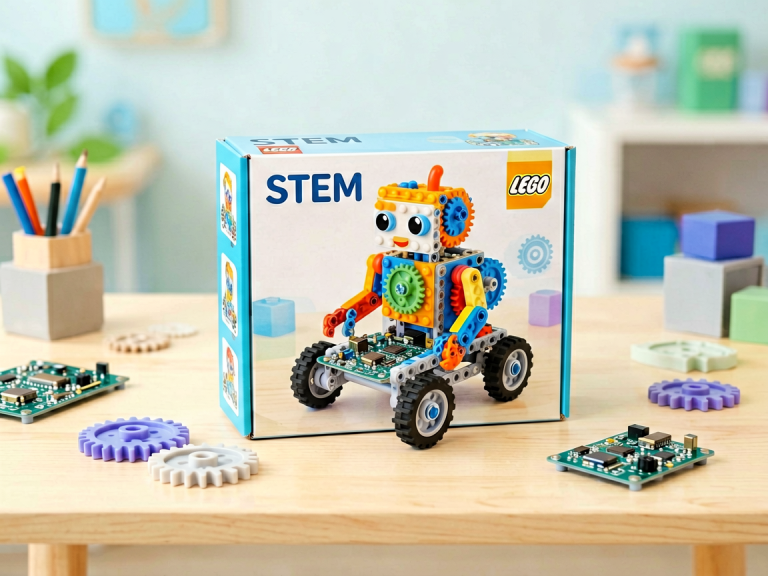
From classic LEGO bricks to magnetic tiles, wooden unit blocks, and interlocking gears, construction toys are the gold standard for independent play. They allow children to experiment with geometry, balance, and structural integrity. A child can spend an hour or more designing a marble run that guides a ball through loops and drops, testing hypotheses about gravity and angle with each adjustment. Advanced sets like K’NEX or Meccano introduce real engineering concepts, while simpler blocks provide sensory satisfaction for younger elementary kids. The key is that the child drives the design; there is no predetermined outcome.
Art, Craft, and Modeling Materials
Open-ended art supplies — watercolor paints, air-dry clay, wool for felting, mosaic tiles, embroidery kits — are ideal for solo creative expression. Unlike coloring books that prescribe outlines, these materials give children complete control. A child might sculpt a mythical creature, then paint it, then decide to add fabric scraps as wings. The process is iterative and personal. For older elementary kids, more structured kits like weaving looms or pottery wheels still leave plenty of room for independent decision-making while teaching a technical skill. The mess factor is real, but a dedicated workspace (like a plastic tablecloth or a tray) makes cleanup manageable and preserves the child’s autonomy.
Puzzles and Logic Games
Solo puzzle-solving builds persistence, pattern recognition, and patience. Jigsaw puzzles with 100 to 500 pieces are classic, but don’t overlook 3D puzzles (like a wooden globe or a dinosaur skeleton), logic puzzles (Rush Hour, Qwirkle solo mode), or maze books. For children who love words, crossword puzzles for kids or anagrams can be absorbing. The satisfaction of completing a puzzle entirely on one’s own — without hints from a parent — is a powerful confidence booster. Even better, many puzzles can be done multiple times; a child may race against their own previous time or try a different strategy.
Role-Play and Small World Sets
While pretend play is often associated with toddlers, elementary children deeply benefit from narrative-driven solo play. A set of plastic animals, small dolls, or a detailed dollhouse invites storytelling. A child might arrange furniture, create dialogue, and act out scenarios. These toys encourage emotional exploration; a child can work through a conflict between two characters in a safe, controlled way. Similarly, a wooden train set with tracks, bridges, and figures allows for boundless creative world-building. The key is that the set is not overly themed with media tie-ins (like a specific movie franchise) that dictate a fixed plot; generic characters and settings invite richer invention.
Science and Discovery Kits
For the naturally curious child, hands-on science kits provide structured yet independent exploration. A microscope with prepared slides, a crystal-growing set, a simple circuit building kit, or a rock tumbler all give the child a clear task but allow for individual variation. The child must follow steps, make observations, and draw conclusions — all core scientific habits. Importantly, these kits should be designed for solo use; avoid sets that require adult supervision for safety (such as chemical experiments with open flames). Many reputable brands now offer age-appropriate kits that are safe and engaging for children aged six and up, with clear pictorial instructions that a child can follow alone.
How to Choose and Introduce These Toys
Selecting the right independent play toys requires attention to the child’s current interests, temperament, and developmental stage. A child who loves movement may thrive with a marble run or a magnetic building set that creates moving mechanisms. A quiet, introspective child might prefer a detailed art kit or a jigsaw puzzle. Parents should observe how their child plays: does the child tend to stick with one activity for a long time, or flit between them? For the easily distracted child, a single, high-quality toy presented in a calm space may be better than a shelf full of options.
Introduce the toy without instructions. One of the most effective strategies is to simply place the toy in the child’s environment and let them discover it. For example, leave a box of magnetic tiles on the living room floor. The child will likely approach, examine, and begin experimenting. Resist the urge to demonstrate “how it works.” The child’s own trial and error is the heart of independent play.
Create an inviting play space. A dedicated corner with a low table, good lighting, and accessible storage helps children take ownership. Rotate toys periodically to keep interest fresh. A child who hasn’t seen a particular toy for a month may rediscover it with renewed enthusiasm.
Respect the child’s play. Once a child is absorbed, avoid interrupting with questions, suggestions, or chores. The deep focus that emerges during solo play is fragile. Even a simple “What are you building?” can break the spell. Let the child come to you when they are ready to share. This respect signals to the child that their play is valuable.
The Long-Term Benefits of Independent Play with Quality Toys
Investing in independent play toys is not just about keeping a child busy. The habits formed during these solo hours ripple into later life. Children who regularly engage in self-directed play develop stronger intrinsic motivation — they learn to pursue activities for the joy of the process, not for an external reward. They become more comfortable with solitude, which is a foundation for self-reflection and emotional resilience. In a world that constantly demands attention and response, the ability to be alone and content is a superpower.
Academically, the skills practiced through independent play — planning, persistence, creativity, and problem-solving — directly translate to classroom success. A child who has spent hours figuring out how to stabilize a block tower intuitively understands concepts of balance and trial and error when encountering a math problem. Similarly, a child who has directed their own art project develops the patience to revise a written essay.
Socially, paradoxically, independent play can improve relationships. A child who knows how to entertain themselves is less likely to be clingy or demanding with peers and adults. They bring richer ideas to group play because they have already explored their own imagination. They also learn to respect others’ need for solitude, an empathy that deepens friendships.
Finally, independent play toys that are open-ended and high-quality often become cherished possessions. They are not disposable entertainment but tools for personal growth. A set of wooden blocks from childhood may be passed down to a younger sibling, carrying memories of towers built and worlds invented. In this way, the toy’s value compounds over time — just like the skills it helps build.
Conclusion
Independent play is not a luxury for elementary children; it is a developmental necessity. The right toys — open-ended, durable, challenging, and screen-free — act as powerful partners in this journey. They invite children to become architects of their own experiences, to face small challenges with courage, and to discover the deep satisfaction of a self-created world. Parents who thoughtfully curate such toys and then step back are giving their children a gift that extends far beyond childhood: the ability to think independently, to find joy in solitude, and to approach life with curiosity and confidence. In the quiet hum of a child deeply engaged with a toy, we hear the sound of a mind growing free.